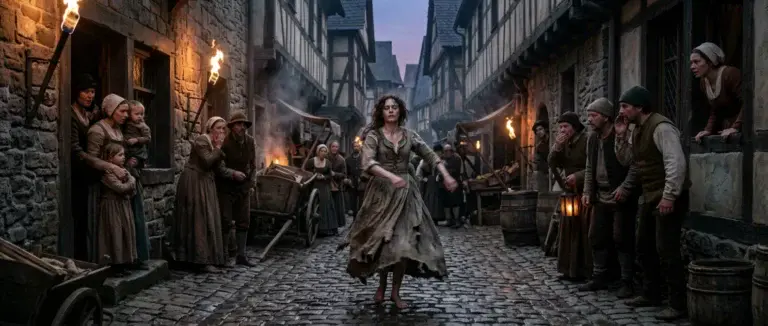


In the summer of 1518, a woman stepped into a narrow street in Strasbourg and began to dance.
There was no celebration. No band played nearby, and nobody had invited her to perform. According to later accounts, she simply started moving—and apparently could not make herself stop.
She danced for hours beneath the summer sun. When exhaustion finally brought her down, the pause did not last. She reportedly rose the following day and began moving again.
Then something much stranger happened.
Other people joined her.
Within days, dozens of residents were dancing through the streets. Some appeared frightened or distressed. Others moved as though they were trapped in a trance. The outbreak continued for weeks, becoming one of the strangest and most unsettling incidents recorded in European history.
Today, we call it the Dancing Plague of 1518. More than 500 years later, historians still cannot say with certainty what caused it.
What Was the Dancing Plague of 1518?
The Dancing Plague of 1518 was a strange outbreak in Strasbourg in which groups of residents reportedly danced compulsively for days. Officials initially encouraged the dancing, believing it would cure the condition, but the outbreak grew worse. Its exact cause remains unknown, although mass psychological distress is considered more plausible than poisoned grain.
Key Takeaways
- The Dancing Plague began in Strasbourg during the summer of 1518.
- Contemporary and later records describe groups of people dancing involuntarily for extended periods.
- The outbreak may have started with a woman commonly identified as Frau Troffea, although some details about her identity remain uncertain.
- Officials initially encouraged the afflicted to keep dancing, believing this would help them recover.
- Reports that hundreds died are not supported by reliable contemporary evidence.
- Modern explanations include mass psychological illness, extreme stress and ergot poisoning.
- Historians generally consider a stress-related psychological outbreak more plausible than poisoned grain.
The Outbreak Was More Than a Legend
Historical chronicles and municipal records support the basic account: groups of people danced in Strasbourg during the summer of 1518, and city officials attempted to control the outbreak. The exact number of dancers, their individual experiences and the reported death toll are less certain.
Where Did the Dancing Plague Happen?
The outbreak occurred in Strasbourg, which is now part of France. In 1518, however, Strasbourg was a free city within the Holy Roman Empire.
Its residents had already endured difficult years. Poor harvests, rising food prices, disease and political uncertainty placed enormous pressure on ordinary families. Hunger was not an abstract concern. Neither was illness.
Religious fear also shaped how people understood misfortune. Many residents believed saints could punish sinful communities with illness. Saint Vitus, in particular, was associated with conditions involving uncontrolled movement.
This environment matters because the Dancing Plague did not unfold in a calm, secure community. It appeared among people already living with intense physical and emotional strain.
Who Was the First Dancer?
The first dancer is usually identified as Frau Troffea, although her name comes from accounts written after the event and should be treated with some caution.
The most familiar version of the story places her in the street outside her home in July 1518. She began dancing without music and continued for several days, stopping only when exhaustion forced her body to rest.
Her husband reportedly begged her to stop, but she appeared unable—or unwilling—to do so.
Authorities eventually took her to a shrine dedicated to Saint Vitus near Saverne. By then, however, the strange behavior had already begun to spread.
Within several days, more than 30 people were reportedly dancing. Later accounts claimed that the number eventually reached several hundred.
The exact total is impossible to verify. What seems clear is that this was not merely one person behaving strangely. Strasbourg’s government considered the situation serious enough to intervene, issue restrictions and arrange treatment for those affected.
How the Dancing Plague Unfolded
July 1518
A woman commonly identified as Frau Troffea reportedly began dancing in a Strasbourg street without musical accompaniment.
Within Several Days
Other residents began moving compulsively. Some accounts claimed that more than 30 people were involved during the outbreak’s early stage.
The City Responded
Officials provided dancing spaces and musicians, believing the afflicted needed to dance until the condition left their bodies.
The Plan Backfired
The public spectacle appears to have attracted additional participants, causing authorities to remove the stages and restrict music.
August or September 1518
Afflicted residents were taken to a shrine associated with Saint Vitus, and the mysterious outbreak eventually faded.
Strasbourg’s Disastrous Cure
City officials consulted local physicians, who rejected the idea that the dancers were possessed. Instead, they reportedly blamed “overheated blood,” an explanation drawn from the medical beliefs of the period.
Their treatment sounds almost unbelievable today.
The dancers, they decided, needed to keep dancing until the condition worked its way out of their bodies.
Officials opened guild halls and arranged public spaces where the afflicted could move. Musicians were reportedly hired to play pipes, drums, fiddles and horns. Healthy dancers may also have been brought in to help keep the exhausted people moving.
In other words, Strasbourg responded to an outbreak of uncontrollable dancing by creating more opportunities to dance.
The plan did not work.
If anything, the public spectacle appears to have attracted more participants. People who already feared the anger of Saint Vitus could see what looked like proof of his punishment unfolding in front of them.
The city had accidentally created the ideal conditions for fear, expectation and imitation to spread.
According to an account in The Public Domain Review, authorities eventually reversed course. The platforms were removed, public dancing was restricted, and most forms of music were temporarily prohibited.
Did People Really Dance to Death?
This is where the popular version of the story becomes less reliable.
You will often see claims that up to 15 people died every day or that hundreds of people danced themselves to death. Those details certainly make the story more dramatic, but they come primarily from later accounts.
Surviving records from Strasbourg do not give us a dependable death toll. They do not clearly establish that anyone died as a direct result of the outbreak.
That does not mean the dancers were comfortable or safe. Dancing for long periods in summer heat could cause dehydration, injury and complete physical exhaustion. Accounts describe swollen feet, collapse and severe distress.
It simply means that we should separate what is documented from what may have been added as the story passed through later chronicles.
Hundreds may have participated. Some may have died. We do not know enough to state either number as settled fact.
Hundreds Danced to Death
Online retellings frequently say that hundreds of people died or that as many as 15 dancers died each day.
The Death Toll Is Unknown
Surviving contemporary records do not provide a reliable death toll. Fatalities may have occurred, but the dramatic numbers come largely from later accounts.
Why Did the Dancing Plague End?
After the city’s attempt to encourage the dancing failed, officials turned toward a religious solution.
The most severely affected dancers were taken to a shrine associated with Saint Vitus. There, they participated in rituals involving prayer, crosses, holy water and specially prepared shoes.
The outbreak faded by late August or early September.
Was the shrine responsible? Perhaps the ritual convinced frightened sufferers that the curse had been lifted. The city’s restrictions may also have removed the public setting that allowed the behavior to spread.
It is even possible that the episode simply exhausted itself.
The timing gives us clues, but not a definite answer.
Was Poisoned Bread Responsible?
One of the most repeated explanations involves ergot, a fungus that can contaminate rye.
Ergot poisoning can cause convulsions, hallucinations, burning sensations and serious problems with circulation. Because some of those symptoms sound vaguely similar to dancing mania, poisoned bread became an attractive explanation.
What Caused the Dancing Plague?
Poisoned Rye
Ergot fungus can cause convulsions and hallucinations, but it also restricts circulation. Severe poisoning would make prolonged dancing physically unlikely.
Mass Psychological Illness
Hunger, disease, religious fear and social stress may have produced genuine physical symptoms that spread through expectation and imitation.
Religious Trance
Shared belief in punishment from Saint Vitus may have influenced how residents experienced and expressed extreme psychological distress.
No explanation has been conclusively proven. Historians are attempting to interpret incomplete records from more than five centuries ago.
There are problems with the theory, though.
Ergotism can make movement extremely painful and restrict blood flow to the limbs. A severely poisoned person would be unlikely to dance through the streets for days. Ergot contamination also does not easily explain why so many people would display the same culturally specific behavior.
Poisoned grain is possible in a very broad sense, but it does not fit the known pattern particularly well. Historian John Waller argued in a scholarly examination of the outbreak that the ergot explanation was not convincing. His research instead emphasized the psychological and cultural conditions surrounding the dancers. ScienceDirect summary
Was It a Mass Psychological Illness?
The leading modern explanation is that Strasbourg experienced a form of mass psychogenic illness, historically called mass hysteria.
This does not mean the dancers were pretending.
Psychological distress can produce genuine physical symptoms, including tremors, weakness, fainting, pain and involuntary movement. When those symptoms emerge within a close community, fear and expectation can cause similar reactions to spread.
The people of Strasbourg were living with hunger, disease, social conflict and powerful religious fears. They also knew stories connecting Saint Vitus with involuntary dancing.
Once one person began moving uncontrollably, observers may have interpreted it through beliefs they already shared. As more people joined, the spectacle reinforced those fears. Hiring musicians and building public stages made the outbreak even more visible.
The dancing may have been physically real even if its underlying trigger was psychological.
This explanation is not perfect. We cannot diagnose people who lived five centuries ago, and the surviving evidence is incomplete. Still, it fits the social conditions and the unusual way the behavior spread better than the poisoned-bread theory.
Historian Lynneth Miller has also emphasized that early explanations were closely tied to the medical and religious ideas of their time. The event cannot be fully understood by stripping away the culture surrounding it. Edinburgh University Press
Dancing Mania Was Not Unique to Strasbourg
Strasbourg’s outbreak was unusual, but it was not the first report of dancing mania in Europe.
Similar episodes were recorded along the Rhine and Moselle rivers during the medieval and early modern periods. One major outbreak occurred in 1374, when groups reportedly moved through towns while dancing, leaping and crying out.
These events were often interpreted as divine punishment, possession or the work of saints. Religious processions and pilgrimages were frequently used as treatments.
The earlier outbreaks may have created a cultural pattern that made the events of 1518 possible. People already knew what a dancing curse was supposed to look like. When the first dancer appeared, the community had a ready-made explanation.
That explanation may have helped shape what happened next.
Strasbourg Was Not the First Dancing Outbreak
Similar episodes of dancing mania were recorded in parts of Europe before 1518, including a major outbreak reported along the Rhine in 1374. These earlier stories may have given Strasbourg residents a familiar pattern through which to interpret the strange behavior.
What Makes the Dancing Plague So Unsettling?
The Dancing Plague is disturbing because it sits in the uncomfortable space between history, medicine and human belief.
Something happened in Strasbourg. Multiple historical sources agree that groups of residents danced compulsively and that city officials attempted to manage the outbreak.
Beyond that, certainty begins to slip away.
We do not know exactly how many people participated. We do not know whether the first dancer was truly unable to stop. We cannot confirm a death toll, and we cannot diagnose the population from records written hundreds of years ago.
Perhaps that uncertainty is what keeps the story alive.
The people of Strasbourg did not need poisoned bread or a supernatural curse to experience something terrifying. Fear, exhaustion, expectation and social pressure may have been enough.
Once an entire community believed the dancing could spread, perhaps it did.
A Mystery That Still Has No Final Step
By September 1518, Strasbourg’s streets had grown quiet again. The musicians were gone, the public stages had been dismantled, and the remaining dancers had been taken away for religious treatment.
The outbreak ended, but its cause was never settled.
Ergot poisoning remains part of the popular story, although the evidence is weak. A mass psychological response to extreme hardship appears more plausible, but even that remains an interpretation rather than a proven diagnosis.
More than 500 years later, the Dancing Plague of 1518 continues to raise an uncomfortable question:
If fear can spread from person to person, how much control do we really have over the ways our minds—and our bodies—respond?
That may be the strangest fact of all. Perception can be stranger still: some people with synesthesia, for example, involuntarily see colors when they hear music or taste spoken words.
The Dancing Plague of 1518 in 35 Seconds
See how one unexplained dancer became the center of one of history’s strangest recorded outbreaks.