


In July of 1518, a woman named Frau Troffea stepped into a narrow street in Strasbourg and began to dance. She had no music. She gave no explanation. She did not stop. Within a week, dozens of others had joined her, and within a month, by some accounts, hundreds of people were dancing through the city with no apparent will to quit, some of them reportedly until they collapsed from exhaustion or died. The event is now known as the dancing plague of 1518, and it remains one of the strangest documented episodes in European history, not because the dancing itself is in doubt but because nobody has ever settled on why it happened.
Three explanations compete for the answer: ergot poisoning, mass psychogenic illness, and religious panic tied to the legend of Saint Vitus. Each has supporters among historians, and each fits part of the record. The question worth asking is which one fits all of it.
Frau Troffea’s first steps and how the dancing spread through Strasbourg
The city records from Strasbourg are specific enough to work with. Frau Troffea began dancing alone, and local authorities, apparently unsure what else to do, responded not by stopping her but by encouraging it. They hired musicians and cleared out a guild hall, then later a grain market and an open space near the cathedral, believing that she needed to dance out whatever ailed her. That decision likely made things worse.
Within days, other residents started dancing alongside her, and the numbers climbed through August. Estimates from the surviving accounts put the number of dancers somewhere between 50 and 400 at the event’s peak, though exact figures vary across sources and modern historians treat the higher end with caution. What is consistent across the records is that the dancing was involuntary in appearance, continued for days at a stretch, and spread through a defined population in a city already under strain from poor harvests and disease.
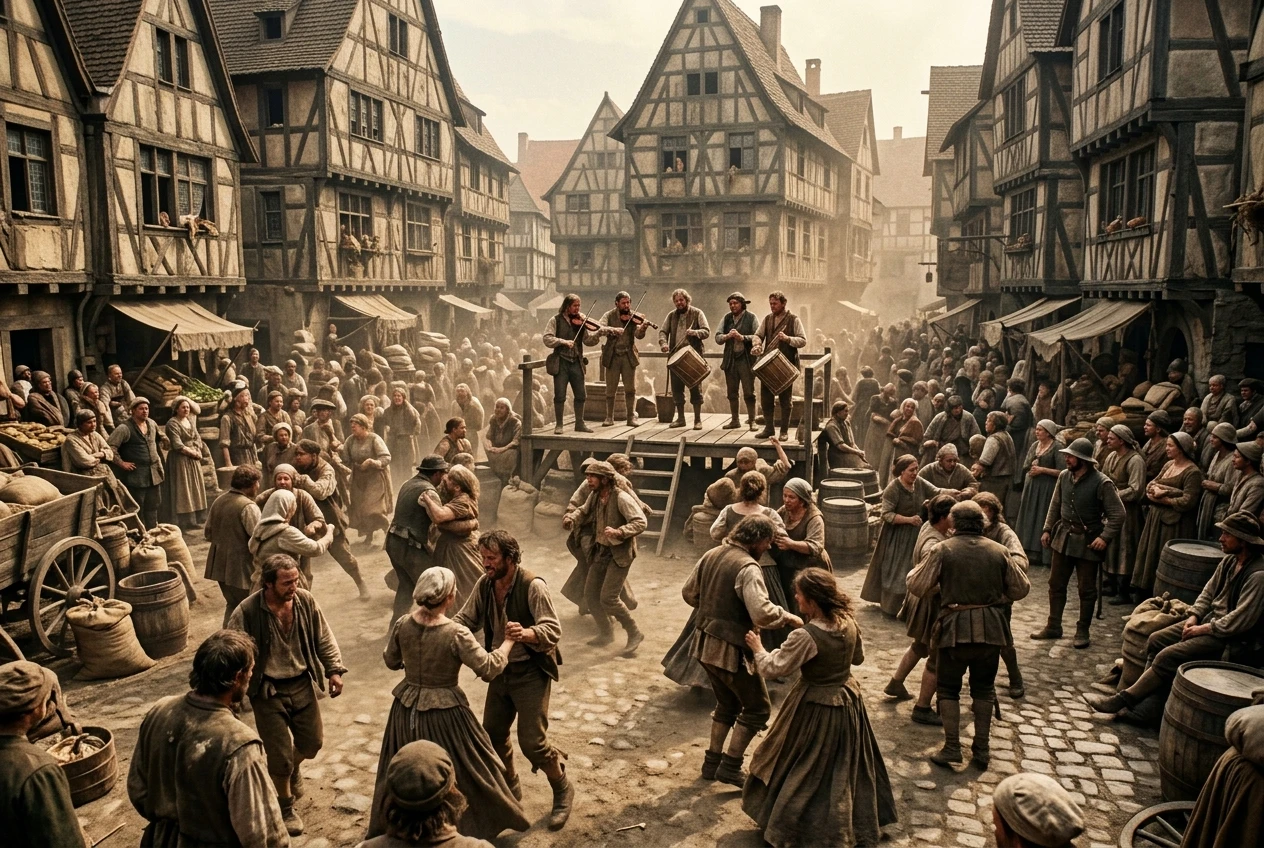
City officials eventually abandoned the idea that music and dancing would cure the afflicted. They banned public dancing, closed the dance halls, and instead sent the dancers to a shrine dedicated to Saint Vitus, where priests performed rites meant to break what was increasingly described as a curse. The episode faded by early September, roughly a month after it had been visible enough for the city to take notice.
What eyewitnesses and physicians actually recorded at the time
The physicians of Strasbourg left behind notes that are unusually practical for the period. They described the dancers as suffering from “hot blood,” a diagnosis rooted in the humoral medicine of the time, which held that an excess of heat in the body could drive a person into involuntary movement. This is why the city’s initial response was to let the dancing continue under supervision rather than suppress it. The thinking was that the heat needed to be worked out of the body, not trapped inside it.
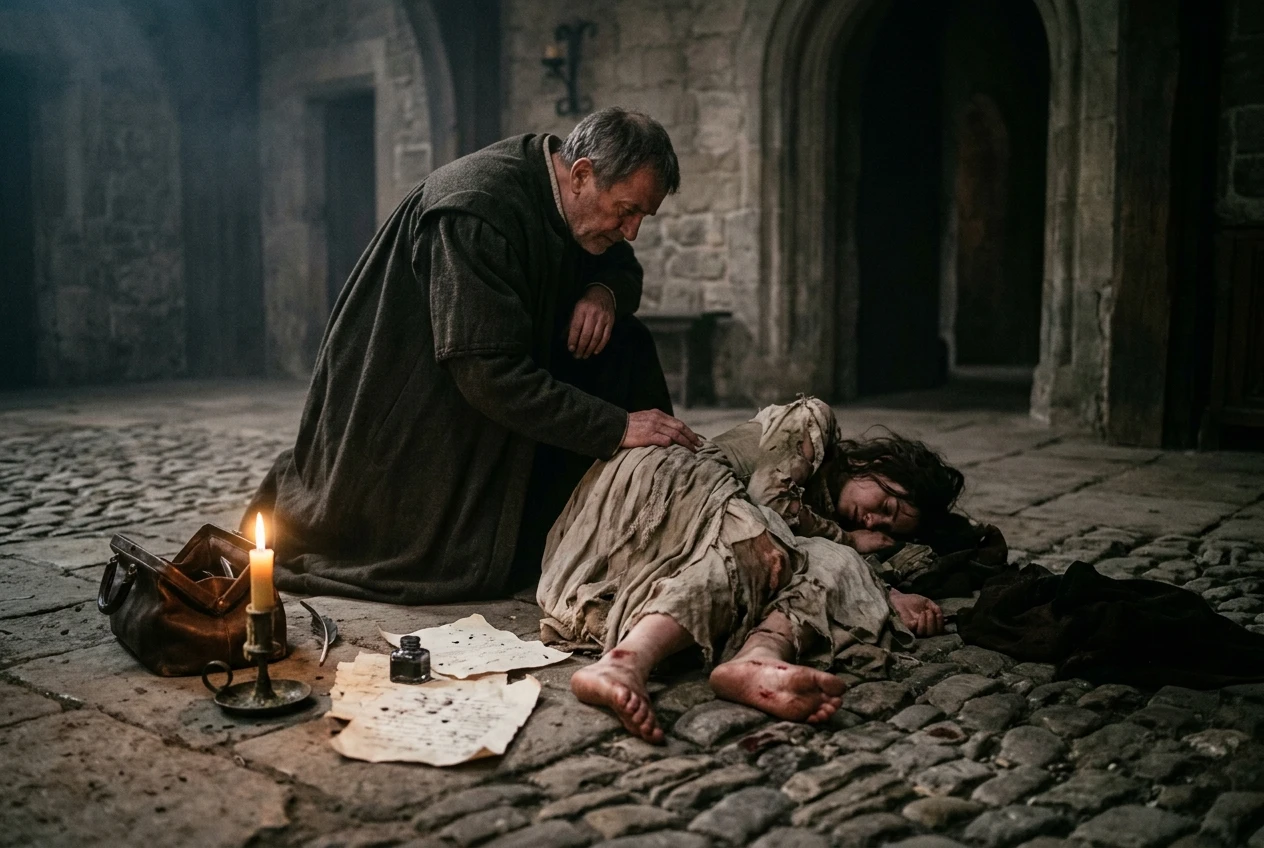
Several chronicles from the period, along with later summaries drawn from physician Paracelsus writing a few decades after the event, describe dancers with glassy expressions, who seemed unaware of their surroundings and unable to stop even when their feet bled or their bodies gave out. Some accounts mention deaths among the dancers from exhaustion or heart failure, though the exact death toll is not reliably recorded and modern historians treat the higher claims with skepticism given how city records of the period tended to exaggerate crisis events for both religious and administrative reasons.
What the records do not describe is as telling as what they do. There is no mention of hallucinations, vomiting, convulsions, or the other physical symptoms that would point clearly toward a poisoning event. The dancers danced. They did not, by the surviving descriptions, show the broader neurological chaos that a toxin would typically produce.
The ergot poisoning theory and why it struggles to explain weeks of dancing
Ergot is a fungus that grows on damp rye, and when consumed, it can cause a condition called ergotism, which produces convulsions, muscle spasms, and in severe cases hallucinations. Rye was a dietary staple in Strasbourg, and 1518 followed years of poor harvests and flooding, conditions under which ergot could plausibly have contaminated the grain supply. This is the basis for the theory, popularized most prominently by historian John Waller, that the dancers were poisoned rather than psychologically afflicted.

The theory has a real problem, though, which is duration and coordination. Ergotism produces erratic, jerking, often painful spasms rather than sustained, directed dancing that can continue for days. The poisoning also does not explain why the affected population grew steadily over weeks rather than appearing all at once, as a contaminated grain supply eaten by many households around the same time would be expected to produce. A single bad batch of rye would likely strike a cluster of people in a short window, not spread outward the way an idea or a behavior spreads through observation and proximity.
There is also the detail of who danced and who did not. Families living in the same households, eating the same bread, did not uniformly join the dancing. If ergot were the cause, exposure should track much more closely with contamination than it appears to in the Strasbourg case, where the dancing seems to have followed social contact more than it followed diet.
Mass psychogenic illness: stress, famine, and the power of belief in 1518
Mass psychogenic illness, sometimes called mass hysteria, describes a condition in which physical symptoms spread through a group not because of a shared toxin or pathogen but because of shared stress, belief, and observation. It has been documented in modern settings, from school outbreaks of fainting and twitching to factory workers reporting illness after a coworker collapses, with no toxin or infection ever found.
Strasbourg in 1518 had the conditions this theory needs. The region had endured famine, crop failure, and a string of disease outbreaks including syphilis and smallpox in the years leading up to the event. Religious anxiety was also running high, with widespread belief in curses, saints’ punishments, and divine retribution shaping how people interpreted unexplained suffering. A population under that kind of sustained stress is, according to this theory, primed to express that stress physically once a triggering event, such as Frau Troffea’s initial collapse into dancing, gives it a shape to take.
This theory explains the gradual spread far better than ergotism does. It also explains why the city’s decision to provide music and space for dancing likely made the outbreak worse rather than better. If the dancing was a stress response amplified by observation and belief, then treating it as a legitimate medical event requiring public space and encouragement would have reinforced the behavior rather than contained it, which matches what the historical record shows happened.
Why religious panic and the curse of Saint Vitus shaped how people responded
Saint Vitus was, by the early sixteenth century, associated in regional folklore with a curse that could compel a person to dance uncontrollably as punishment for sin or as a divine affliction. This belief was not fringe. It was embedded in how ordinary people and even physicians of the time interpreted the body and its ailments, and it shaped the city’s response just as much as any medical theory did.
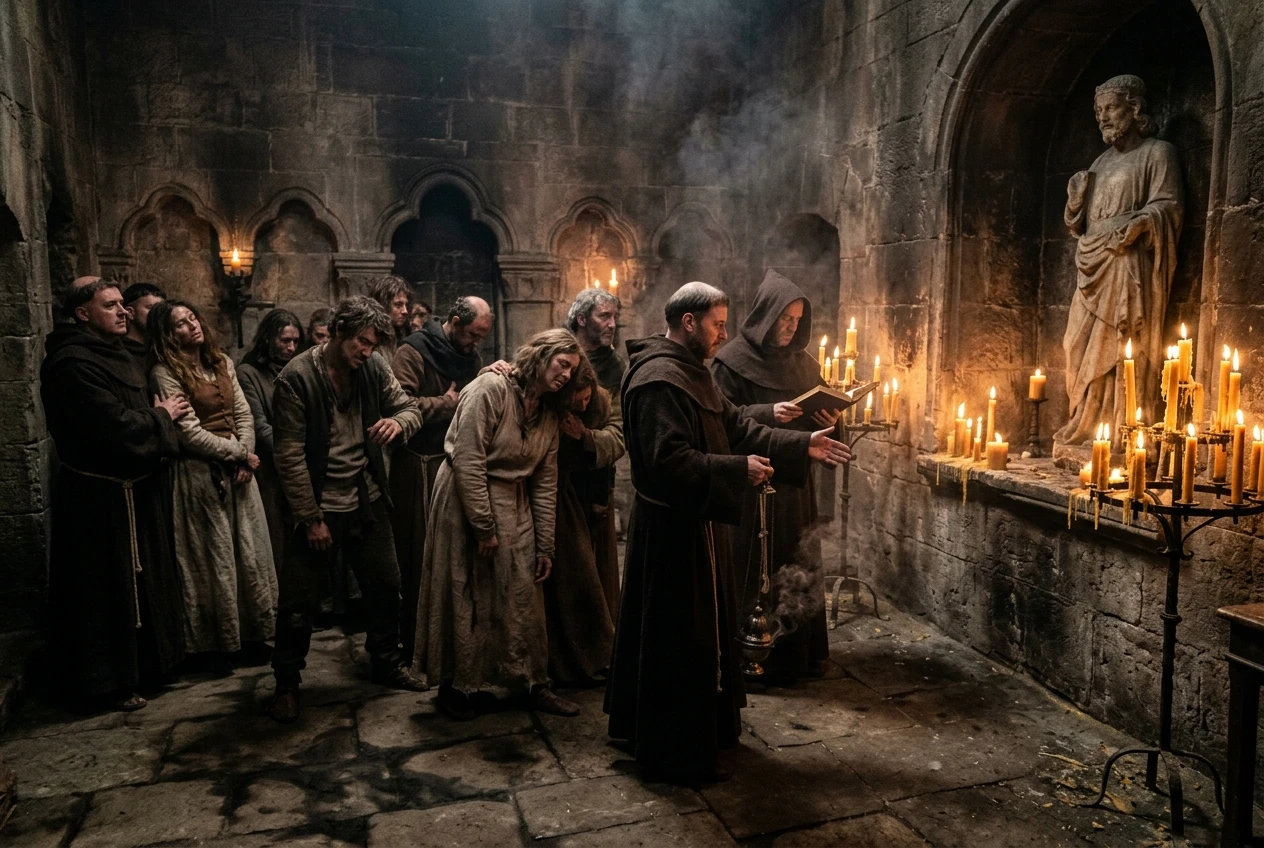
Once officials moved the dancers to the Saint Vitus shrine for religious intervention, the framing of the event shifted from a medical crisis to a spiritual one. This likely mattered for how the episode ended as much as for how it began. If the dancing was sustained by belief and social reinforcement, then a change in the dominant belief, from “dancing is a cure that should be encouraged” to “dancing is a curse that must be broken through penance,” could plausibly have helped end the outbreak by removing the social structure that had been sustaining it.
Religious panic, then, is less a standalone explanation for the dancing plague of 1518 and more the lens through which the city understood and responded to it, a lens that likely shaped the outbreak’s trajectory at both ends.
Weighing the evidence: which explanation holds up best today
Of the three explanations, mass psychogenic illness fits the surviving record most closely. It accounts for the gradual spread of the dancing through a population under severe and documented stress, it accounts for the absence of the broader physical symptoms ergotism would produce, and it accounts for why civic and religious responses, rather than medical treatment, appear to have shaped how the episode unfolded and ended.
Ergot poisoning remains a plausible contributing factor rather than a complete explanation. Conditions for ergot contamination existed in the region, and it is possible some residents were affected by it independent of the dancing event. But as a sole cause for weeks of sustained, socially spreading dance behavior, it does not match the pattern recorded in Strasbourg’s own documents.
Religious panic is best understood as the frame rather than the cause, the belief system that gave the dancing its meaning and shaped the city’s interventions. It explains why people responded the way they did far better than it explains why the dancing started in the first place.
What the dancing plague still tells us about unexplained collective behavior
The dancing plague of 1518 is a reminder that physical symptoms do not need a toxin or a pathogen to spread through a group of people with force and apparent authenticity. Belief, stress, and observation can produce outbreaks that look, to the people living through them, indistinguishable from disease. Strasbourg’s physicians treated the dancers with the medical vocabulary available to them, and the city’s choice to provide space and music for dancing, however well intentioned, likely extended a crisis it was trying to resolve.
For more documented cases that still defy easy explanation, see real unexplained phenomena that still puzzle scientists.