

Most people don’t meet UAPs in the sky, they meet them on a screen or a page.
UAP (Unidentified Anomalous Phenomena) is the newer umbrella term that replaces “UFO” in many official settings, and that wording shift matters more than it sounds. “UFO” carries a tabloid echo, while “UAP” reads like a category on a safety report. Since the release of official Navy videos, open congressional talk, and ongoing Pentagon summaries through AARO, the topic has moved from punchline to paperwork.
This post isn’t here to prove alien life. It’s about cultural influence: how stories shape what we expect UAPs to be, and how that feedback loop can help serious study or harden belief, even when a case turns out to be something ordinary.
From flying saucers to UAP, how real-world policy changes reshaped the stories we tell
Cold War fear on screen: aliens as a stand-in for invasion, spying, and the bomb
In the 1950s, American sci-fi didn’t just entertain; it also shaped the world. It often translated the day’s worries into something you could see and point at. A stranger replaces your neighbor in Invasion of the Body Snatchers. A “thing” slips past defenses. The fear wasn’t always “aliens.” It was infiltration, nukes, and the sick feeling that the rules had changed overnight.
That mood coincided with the US government’s formal investigations. The Air Force moved from early efforts like Project Sign (1948) and Project Grudge to Project Blue Book (1952–1969). Those programs weren’t movie scripts, but they fed public curiosity because they confirmed one thing: officials were receiving reports, cataloging them, and trying to explain them.
So culture did what culture does. It filled in the blank spaces. Sometimes with careful wonder, sometimes with paranoia, and sometimes with rubber suits.
The modern disclosure era: when UAP became a safety and intelligence topic
Fast-forward, and the tone changes. In the late 2010s, reporting on Pentagon efforts and the UAP issue gained renewed mainstream traction. By 2020, the Department of Defense had publicly released declassified Navy videos showing encounters that pilots couldn’t immediately identify. The public response was different from earlier decades. Less laughter, more “Wait, what was that?”
A key shift is framing. Modern Pentagon language often treats UAP as a flight safety and intelligence issue. AATIP (the Advanced Aerospace Threat Identification Program) looked at incidents tied to military operations. Its attention to multi-sensor information (radar, infrared, trained eyewitnesses) raised the bar above the old “one person saw a light” pattern, without proving a non-human cause.
Then came structure. AARO (the All-domain Anomaly Resolution Office) is now the Department of Defense hub for UAP-related collection and analysis, with public-facing, unclassified summaries and historical documentation, including the AARO historical record report (February 2024). In January 2026, news reporting about new Pentagon updates described large numbers of recent UAP reports, many of which were resolved as balloons, drones, birds, satellites, or aircraft, plus a smaller set still unresolved, often near sensitive sites. That split is the story of the era: better pipelines, more data, and still a residue of uncertainty.
Movies and TV that shaped what people expect UAPs to be
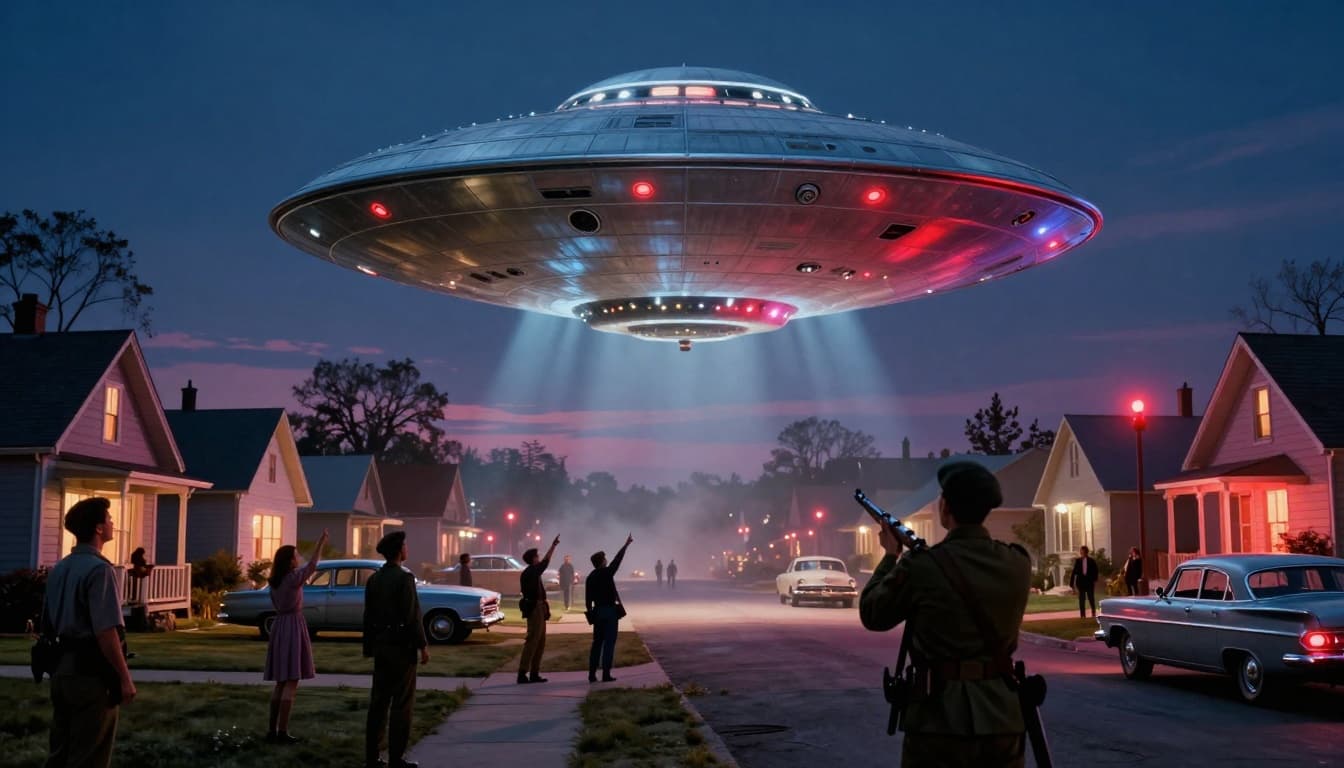
Film and TV don’t just borrow from sightings. They teach the audience what a “real” UAP encounter is supposed to look like. A glowing disk. A sudden stop. A government agent who won’t answer questions. Once those images are in your head, they can steer how you interpret anything ambiguous in the sky.
That’s the loop: reports inspire stories, stories shape attention, and attention shapes the next set of reports.
Big-screen UAP moments that moved from fear to awe
No film did more to pivot the vibe than Close Encounters of the Third Kind (1977). It didn’t treat contact as a monster problem. It treated it as a communication problem, with the human characters pulled forward by curiosity they can’t explain.
There’s also a real-world connection that’s easy to verify and easy to miss: Steven Spielberg consulted astronomer J. Allen Hynek, who had worked with Project Blue Book as a scientific advisor. That detail matters because it quietly told audiences, “This topic isn’t only for tabloids. People in lab coats were involved, too.”
That “awe” lane keeps showing up in prestige sci-fi. Later films like Arrival (2016) center on language, perception, and misread signals, which nudges the public toward a calmer question: if the unknown exists, how would you even begin to understand it?
The X-Files and the rise of the “I want to believe” mindset
Then TV took the wheel. The X-Files didn’t invent government secrecy stories, but it made them feel weekly and familiar. Roswell lore, Blue Book-era whispers, abduction claims, shadow agencies, it all became a living room ritual.
The cultural effect was double-edged.
On the good side, it created space for curiosity. People could talk about sightings without instantly getting laughed out of the room.
On the messy side, it trained a default assumption: if you can’t explain it fast, someone must be hiding the truth. That reflex still shows up today when a UAP clip goes viral, and the comment section jumps straight to “cover-up,” even before anyone checks the basics.
Books, podcasts, and the internet: how UAP ideas spread, stick, and evolve

Movies give you scenes. Books give you frameworks. Podcasts give you a voice in your ear, telling you what it “really” means. Put those together with social feeds, and you get a powerful engine for belief.
And here’s the twist: more cameras don’t automatically mean more truth. It means more material, more angles, and more chances to be fooled.
Influential books that built today’s UAP belief systems
Two lanes dominate modern UAP reading.
First, theory-building that offers a sweeping explanation. Erich von Däniken’s Chariots of the Gods (1968) popularized “ancient astronaut” ideas, reframing myths and monuments as misunderstood technology. That style of thinking still fuels hit franchises like Ancient Aliens. It’s not proof, but it’s a story frame that can make almost any artifact feel like evidence.
Second, cultural analysis that asks why the topic sticks. D.W. Pasulka’s American Cosmic (2019) examines how technology culture, media, and “insider” networks can begin functioning as a new kind of authority over non-human intelligence. It’s less “here’s the craft” and more “here’s how belief forms in a modern society that trusts devices, not institutions.”
Both lanes matter because people don’t interpret a strange light from scratch. They interpret it through the books and stories they already have.
Digital mythology in 2026: when everyone can publish “evidence.”
In 2026, a single clip can hit TikTok, jump to YouTube, get “enhanced” by strangers, and end up discussed like a case file by dinner.
The paradox is brutal: we have more footage than ever, but trust is harder. Editing apps are simple. AI-generated fakes are cheap. And the algorithm likes certainty, even when the data doesn’t.
Recent Pentagon reporting has also made a point that’s uncomfortable but important: the volume of UAP entertainment can reinforce belief, even when investigators later find a mundane explanation for a specific event.
A simple reader practice helps:
- Pause before sharing.
- Check the source (original upload, date, location, any corroboration).
- Separate story from data (what’s observed vs what’s assumed).
That’s not cynical. That’s how you keep curiosity intact.
Conclusion
UAPs didn’t become culturally powerful because everyone agreed on what they are. They became powerful because they sit at the edge of real uncertainty, and culture hates a blank space.
Policy shifts, from Blue Book to AARO, changed the tone from ridicule to reporting. Movies and TV taught the public what an encounter should feel like. Books and internet media supplied the scripts people use to interpret the ambiguous.
The grounded stance is still the best one: study safety and intelligence risks seriously, don’t jump straight to aliens. The open questions remain: what the unresolved cases are, how much data can be shared, and how stigma shapes reporting. Want a calm next step? Follow primary documents, official releases, and careful journalism, then let the evidence earn your belief.