

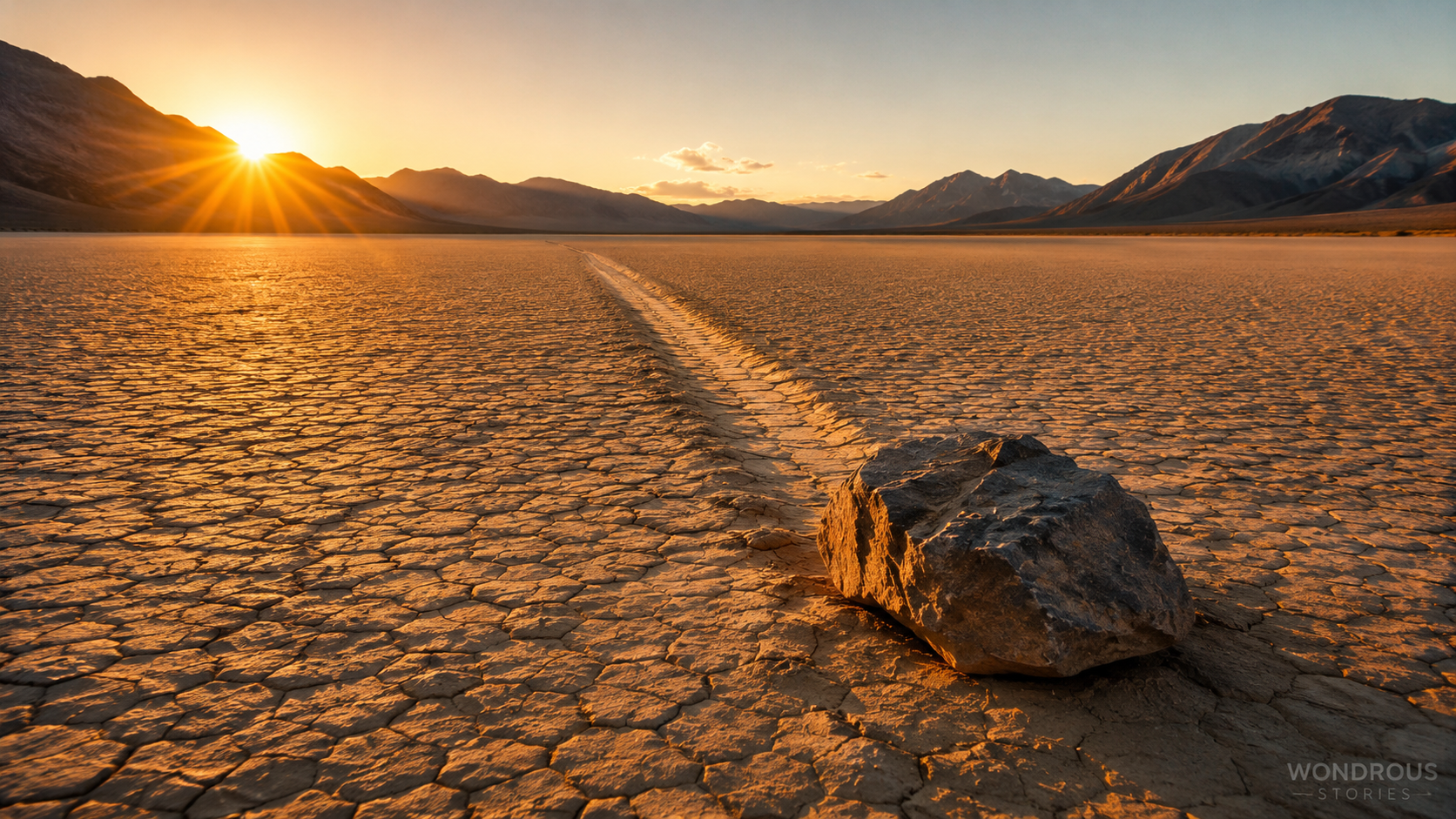
On Racetrack Playa in Death Valley, stones have been leaving tracks across a dry lake bed for more than a century. People kept finding the evidence after the fact, usually at daybreak, with no one around who had seen the motion happen.
The place looks too open to hide anything, which made the case harder, not easier. The rocks were real, the trails were real, and for decades the cause stayed out of sight. The short video below captures why this stretch of desert kept its reputation for so long.
The strange stage at Racetrack Playa
A dry lake bed that records movement
Racetrack Playa is a wide, flat lake bed, dry, bare, and open for miles. From a distance it can look like a giant parking lot laid across the desert. There are no trees, no brush, no soft sand to swallow a trail.
The surface is hard-packed enough to hold a mark, which means even slow motion can leave evidence behind. That is what made this place different. A moving stone didn’t disappear into the landscape. It wrote its path into the ground.
What people kept finding in the morning
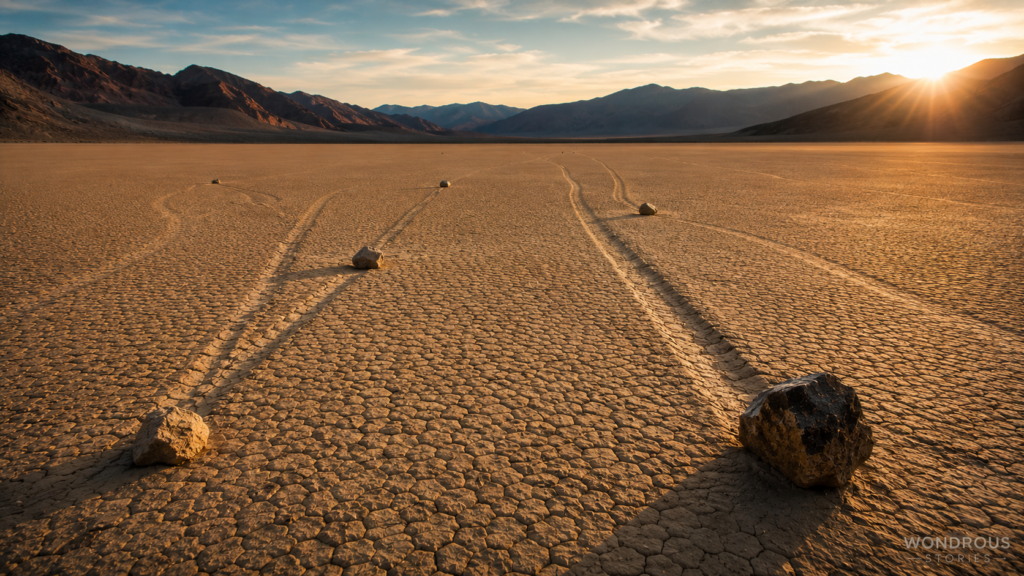
Researchers and visitors would return and see stones sitting far from their earlier positions. Some were small enough to lift. Others looked more like furniture than loose rock. Behind them sat long grooves cut into the playa, sometimes running for hundreds of yards.
A few things kept standing out:
- deep furrows in the crust
- long tracks, often strikingly straight
- no plain sign of earthquakes, flooding, or people moving the stones
That was the trouble. The evidence looked deliberate, but no one could point to a hand, a machine, or a clear weather event that had done it.
The rocks looked too heavy to budge
Stones the size of small appliances
This wasn’t a story about pebbles skittering across dust. Some of the rocks weighed hundreds of pounds. A few were compared to refrigerators. Seen up close, they looked planted, not mobile.
That scale changed the whole picture. Wind can move sand. Water can move mud. A heavy boulder sitting on a dry lake bed is another matter. When one of those stones shifted position overnight, the mystery got harder, not easier.
The trails made the case stronger
The tracks weren’t random scuffs. Many ran in clean, straight lines. Some carved deep grooves through hard ground, as if the stones had been pushed with slow, steady force instead of knocked around by chaos.
That gave investigators a real problem. If pranksters had dragged them, where were the obvious signs? If floodwater had done it, why did the movement look so controlled? The playa kept offering physical evidence, but it refused to give up the full sequence behind it.
Heavy rocks were moving across open ground, and the ground itself kept the record.
A century of evidence kept the story alive
Scientists kept coming back
This wasn’t a one-season oddity. Scientists documented the moving rocks for over a century. The basic facts held up again and again: stones changed position, trails appeared behind them, and the motion usually happened when no one was there to watch it.
That long record is what gave the case weight. The story didn’t survive on rumor alone. It survived because the playa kept producing the same kind of evidence.
The 1950s and 1960s made it harder to dismiss
Field expeditions in the 1950s and 1960s found that some rocks had moved more than once. That mattered. These weren’t isolated marks left by a single odd night. The lake bed kept doing it again.
A short timeline shows how the record built:
| Period | What was documented | Why it mattered |
|---|---|---|
| More than a century | Shifted stones and fresh tracks | The movement was real and recurring |
| 1950s and 1960s | Repeated rock movement during field studies | It wasn’t a one-off event |
| 2014 | Direct observation of rocks moving | A mechanism was finally seen |
Morning after morning, researchers came back to the same surprise: a rock that had been still was now somewhere else. That’s why the case stayed in geology, and why it also drifted into the wider world of documented mysteries, much like the Hessdalen Lights mystery in Norway, where the evidence arrived long before a settled explanation.
Theories rushed in before the answer did
Magnets, aliens, and everything in between
When heavy rocks move and nobody sees it happen, bad theories arrive fast, much like the claims that grew around the Klerksdorp spheres. Some people talked about underground magnets. Others went further and floated alien activity. Those ideas fit the mood of the mystery, but they didn’t come with proof.
That is what happens when a real event sits in plain sight without a witnessed mechanism. The gap fills up. First with guesses. Then with stories.
Why the obvious answers failed
For years, the familiar explanations didn’t land cleanly. Strong wind alone sounded possible, but many observers looked at the weight of the stones and the shape of the trails and didn’t think gusts were enough. Human interference also fell apart without clear signs on the ground.
So the case held. Scientists weren’t dealing with folklore. They were dealing with a physical process that happened under conditions rare enough to escape direct observation for decades.
The 2014 observation changed the case
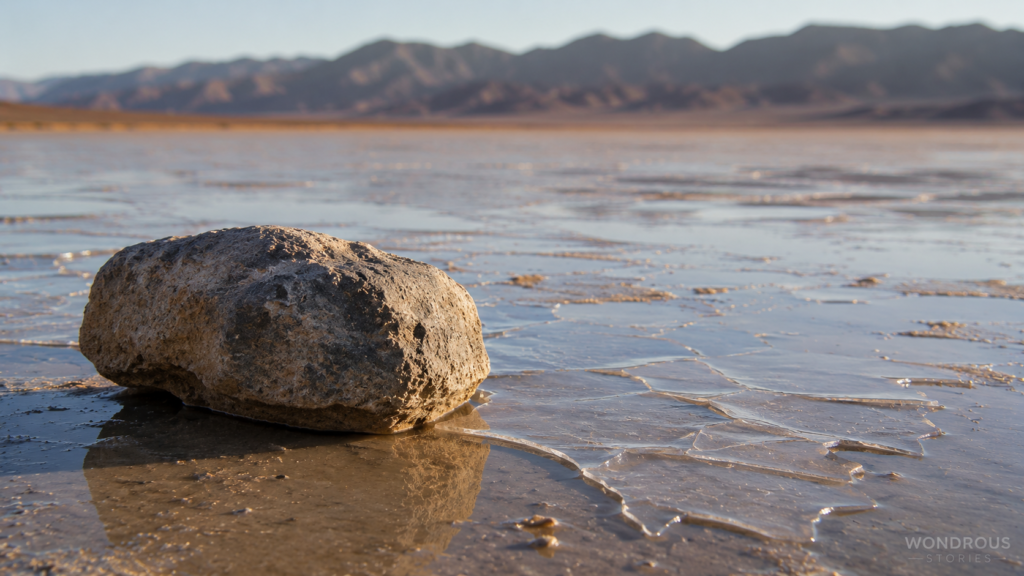
Thin ice formed overnight
In 2014, scientists finally saw the rocks move during a rare weather event. Thin sheets of ice formed on the playa overnight. By morning, those sheets began to break apart.
That was the break the story had needed for generations. For the first time, the movement wasn’t being inferred from tracks after sunrise. It was being watched as it happened.
Wind pushed the ice, and the ice pushed the stones
Once the ice fractured, morning wind nudged the floating panels across the wet playa. Those thin sheets acted less like a battering ram and more like a slow conveyor belt. As the ice moved, it pushed stones along the surface.
The breakthrough was thin ice, light wind, and timing.
That explanation turned the impossible into something physical and testable. It also explained why the mystery lasted so long. The right conditions were brief, easy to miss, and usually gone by the time anyone arrived to inspect the playa.
What the ice explanation answers, and what it doesn’t
The main mechanism is now on record
The 2014 observation answered the central question. Rocks at Racetrack Playa can move when thin ice forms, breaks into panels, and wind pushes those panels across the surface. That is the strongest documented explanation for the phenomenon.
It also fits much of the older record. The playa needed a narrow set of conditions, not constant force. That helps explain why the motion seemed to happen overnight and why witnesses almost never caught it live.
Older trails still leave gaps in the record
What stays uncertain is the night-by-night reconstruction of older cases. Many famous tracks were found after the fact, without a full weather record attached to them. In some of those moments, observers saw no ice by the time they reached the playa.
That doesn’t undo the 2014 finding. It means the main mechanism is clear, while some earlier movements can’t be matched to one exact sequence of conditions. The sailing stones aren’t magic. The desert simply hid the method well, and it hid it for a long time.
Why Racetrack Playa Still Feels Strange
The strange part of Racetrack Playa was never the lack of evidence. It was the opposite. The stones moved, the ground kept the record, and the cause stayed out of sight until the right morning finally exposed it.
Today the picture is clearer, even if the older trail record can’t always be rebuilt in full. That is why these moving rocks still hold up as one of Death Valley’s most unsettling documented events.
Frequently Asked Questions
Do rocks really move by themselves in Death Valley?
Yes. The rocks at Racetrack Playa really do move and leave trails behind them. For decades nobody saw the movement happen directly, which helped turn the phenomenon into a mystery.
What causes the moving rocks at Racetrack Playa?
Scientists observed the movement in 2014. Thin sheets of ice formed overnight, broke into panels, and light wind slowly pushed the ice across the wet playa surface. The ice then pushed the rocks.
How heavy are the Death Valley sailing stones?
Some of the stones are small enough to lift by hand, while others weigh hundreds of pounds. A few have been compared in size to small appliances.
Why did the mystery last for so long?
The conditions needed for movement are rare and brief. Thin ice, shallow water, and steady wind had to happen at the same time, usually during moments when nobody was watching.
Are the moving rocks still considered a mystery today?
The main explanation is now documented, but some older trails and events cannot always be matched to exact weather conditions. The mystery is much smaller than before, but some details from older records remain uncertain.