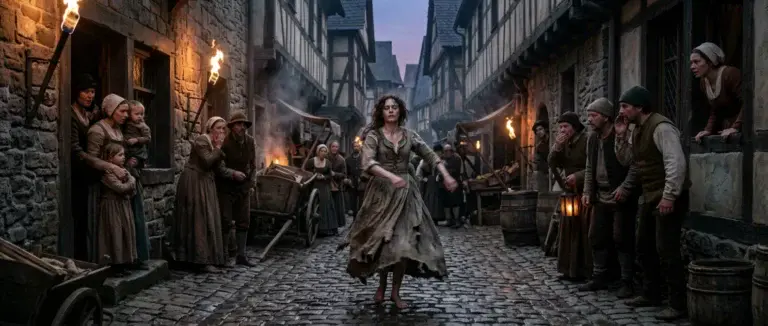

Circleville, Ohio, was a small town when the first anonymous letters arrived in 1977. What followed lasted about 17 years, spread to scores of residents, and built one of the most stubborn unsolved cases in modern Ohio history.
The reason the case still holds people is simple. The letters exposed private lives, pressed for action, and kept coming even after a man went to prison in connection with the campaign. That left a hard question behind: who knew so much, and how?
A quiet Ohio town changed in 1977
The first letters
The Circleville letters did not start as random crank mail. They arrived with purpose. They named names, hinted at affairs, and referred to personal matters that should have stayed inside homes.
Soon, people in town understood the threat. This was not one letter to one family. It was a stream of anonymous messages sent across the community, and the writer seemed to know where pressure would hurt most.
The main focus quickly became school bus driver Mary Gillispie. The letters accused her of having an affair and pushed her to leave her job. That campaign did not fade. It hardened.
Why the Circleville letters felt so threatening
Secrets no outsider should know
What made the mail so disturbing was not only the abuse. It was the level of detail. The writer seemed to know things that usually stayed behind closed doors, including:
- hidden affairs
- family scandals
- private conversations
That gave the letters a force that ordinary harassment rarely has. People could ignore insults. It was much harder to ignore a stranger who appeared to know the truth, or something close enough to it.
Pressure, exposure, and fear
The letters were built to corner people. Some threatened exposure unless demands were met. Others aimed to humiliate, split families, or force someone out of a public role.
Over time, the scale grew. Reports tied the case to more than 1,000 letters sent over roughly 17 years. Homes, officials, and school-connected targets all fell into the line of fire. Circleville did not face one loud attack. It lived under a long campaign of pressure.
The hardest fact in the case is also the simplest one: the letters outlasted every easy explanation.
Mary Gillispie became the main target
Accusations that would not stop
Mary Gillispie was a school bus driver, and the writer kept returning to her. The letters accused her of an affair and demanded that she quit her job. They did not read like gossip passed around a town. They read like instructions backed by threat.
That focus matters because it shaped everything that followed. Once Mary became the center of the letter campaign, the case moved from rumor to sustained harassment. Her family got pulled in, and so did the wider community.
A campaign built on humiliation
Anonymous letters carry a special kind of power in a small town. They spread doubt without showing a face. They also force every target to wonder who is watching and who is talking.
That seems to be what happened in Circleville. The writer kept pressing on the same weak points, private relationships, public reputation, family strain. The letters did not need to prove every claim. They only needed to make people believe the writer was close by and informed.
Ron Gillispie’s death and the case turning violent
A fatal confrontation in 1977
Mary’s husband, Ron Gillispie, took the letters seriously. As the pressure rose, he tried to deal with whoever was behind them. Then the case lurched into something darker.
In 1977, Ron died in a crash after leaving home with a gun following another threatening contact tied to the letters. The timing fixed his death inside the story of the Circleville Writer, even though it never produced a clear, final answer about who had pushed events that far.
The roadside trap in 1983
The next major turn came years later. In 1983, Mary found a threatening sign on her bus route. When she pulled it down, authorities found that it had been rigged with a gun. This was no longer only a letter campaign. Someone had set a trap.
Investigators traced the weapon to Paul Freshour, Mary’s brother-in-law. He was later convicted of attempted murder and served about 10 years in prison. For many people, that looked like the point where the mystery should have narrowed. Instead, it widened.
Paul Freshour’s conviction did not end the letters
Prison only made the case stranger
Freshour’s conviction solved part of the violence in the case, but it did not settle the central question. Letters continued while he was incarcerated. They still carried the same hostile tone, the same interest in Mary Gillispie, and the same air of inside knowledge.
That is the piece that has kept the Circleville Writer case alive. If Freshour acted alone, the ongoing letters are hard to explain. If he did not act alone, the public record never named the full group with proof.
Handwriting became part of the argument, but not its clean answer. Some people saw similarities that tied Freshour to the mail. Others pointed to the continuing letters as proof that the writer, or another writer, remained free.
A short timeline of the case
The broad shape of the case is easier to follow in sequence:
| Year | Event | Why it mattered |
|---|---|---|
| 1977 | Anonymous letters begin in Circleville | The writer starts exposing private matters and targeting Mary Gillispie |
| 1977 | Ron Gillispie dies after a threatening episode tied to the case | The campaign appears to move from harassment to deadly consequence |
| 1983 | A gun trap is found on Mary’s bus route | The case becomes a direct attempted killing |
| 1980s to early 1990s | Letters continue, including during Paul Freshour’s prison term | The mystery remains unresolved |
The timeline is what keeps the case from closing neatly. Each time the story seems ready to settle, another fact refuses to fit.
Why the Circleville Writer case still resists a clean answer
The handwriting problem and the inside knowledge
Most unsolved cases narrow around motive, opportunity, or physical proof. This one scattered in the opposite direction. The deeper people looked, the more the writer’s knowledge stood out.
The letters described personal matters with unsettling accuracy. That suggested an insider, someone near the families involved, or someone with access to private talk. Yet no definitive public identification ever tied all of the letters to one person in a way that ended the dispute.
What is still unknown
The biggest gaps remain the most basic ones. No public resolution has explained who wrote the full run of letters. No firm answer has explained how the writer knew so much. No later event erased the doubt created by the letters that kept arriving while Freshour was in prison.
That is why the case still hangs there. It has records, suspects, a conviction, and a long paper trail. It still lacks the one thing that would make the story feel finished, a proven author behind the fear.
After 17 years, the Circleville Writer left more than rumor. The case left a record of harassment, a family shattered by death and suspicion, and a conviction that did not close the book.
That is why the story lasts. The writer’s identity remains unknown, and the source of the private information has never been fully explained.
Like this article? Also Check out Time Slips