
The story of Zana has lasted because it did not come down as pure folklore. It came tied to a place in the Caucasus, a date in the mid-1800s, a landowner’s name, children, and later scientific interest in her family line.
That gives the case weight. It also means the record has to be handled carefully. The old descriptions are vivid, but vivid is not the same as reliable.
How Zana entered the historical record
Captured in the Caucasus
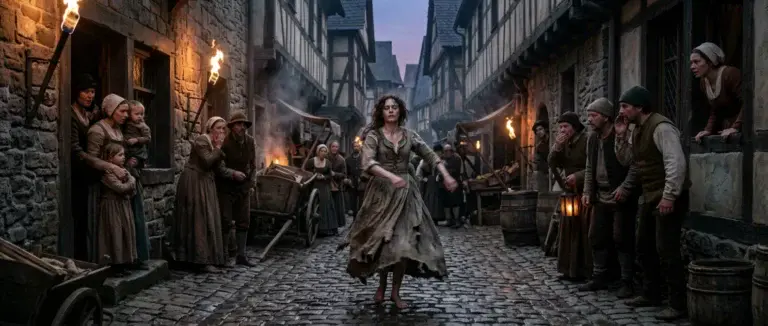
Around 1850, Russian hunters reportedly captured a woman living wild in the Caucasus Mountains. Local accounts described her as more than 6 feet tall, unusually strong, and covered in reddish-black hair. Those are the details that made the story stick.
They also said she did not speak in any way the locals understood. That point matters. Saying she “couldn’t speak any human language” goes further than the evidence allows. What the record supports is narrower: witnesses did not recognize her speech, and they treated her behavior as alien.
A woman of that reported height would have drawn notice anywhere in the 19th century. Add the hair, the strength, and the isolation of the setting, and the case had everything needed to turn into a legend fast. Still, the early picture comes from recollection and retelling, not from a medical file made at the moment of capture.
That is the first hard limit on the story. There was a captive woman called Zana. There were local descriptions of her appearance and behavior. Beyond that, the certainty drops.
Kept on Edgi Ganaba’s estate
Accounts say a nobleman named Edgi Ganaba kept Zana on his estate. Over time she learned basic tasks and lived under supervision, but the plain fact is ugly enough without dressing it up. She was a captive.
Later reports say she had four children with local men. That changed the whole shape of the case. A mountain story became a family line, and a family line can be followed, measured, and studied.
Once children entered the record, people began looking for inherited signs. That is where description starts to blur with expectation. If villagers already believed Zana was something outside the human norm, they were going to read her children through that same lens.
Why her descendants became central to the mystery
The family kept the story alive
Zana’s children are one reason the case never died out. Accounts say some of them showed unusual physical traits that kept local attention fixed on the family for years. The details vary from telling to telling, which is another reason to stay cautious.
What can be said is simple. Her descendants were known, remembered, and later examined. That is rare in stories of “wild people,” which usually dissolve into rumor long before anyone can check anything.
The case then narrowed around one descendant in particular, her grandson Khwit. By the 1960s, Soviet scientists were studying him and recording his physical features. Once that happened, the story crossed from oral memory into formal investigation.
The Soviet examination of Khwit
Soviet researchers documented what they described as primitive cranial features and other traits they did not think matched typical local populations. In the language of the time, that sounded explosive. It gave the Zana story scientific backing, or at least the appearance of it.
But old anthropological language can mislead. “Primitive” is a period term, not a verdict. Skull shape and facial structure can show variation inside normal human populations, and physical measurements alone cannot prove that someone came from a separate species.
Khwit’s examination still mattered. It preserved the idea that there might be something unusual in Zana’s ancestry, and it gave later writers a basis for bigger claims. This is where the case began to drift toward talk of Neanderthals and unknown hominids. The measurements opened the door. They did not settle the question.
What later DNA testing did, and did not, prove
The strongest evidence came much later
Genetics was supposed to answer what eyewitness accounts and skull measurements could not. In one sense, it did. It narrowed the field.
Popular retellings often say DNA from Zana’s descendants stayed mysterious or did not align with modern humans. That line keeps circulating. The published genetic work has not confirmed a surviving Neanderthal, and it has not established Zana as an unknown hominid species.
Here is the cleanest way to read the evidence:
| Question | What the evidence supports | | | | | Was Zana proven nonhuman? | No. DNA results have not shown that. | | Was Neanderthal ancestry confirmed? | No published result established Zana as a surviving Neanderthal. | | What did later genetic work point to? | Modern human ancestry, with African origin reported in later analyses. | | What remains unclear? | How Zana reached the Caucasus, and how reliable the earliest physical descriptions were. |
That does not erase the case. It changes it. If the family line falls within modern human ancestry, then the old question, “What species was she?” loses force. A tougher and more human question replaces it: who was she, and how did she end up in the Caucasus under those conditions?
That pattern shows up in other stories about unknown hairy beings. Grand claims often shrink once real samples get tested, much like they do in the origins of the Bigfoot legend.
Why the DNA story still gets distorted
Part of the confusion comes from the way the case has been repeated. Early descriptions were dramatic. Soviet measurements sounded dramatic. By the time DNA entered the conversation, many people wanted confirmation of the old myth.
They did not get it. What they got was more restrained, and more useful. Genetics placed limits on what can honestly be claimed. It did not explain every witness report, but it did make the “last of her species” line much harder to defend.
The oldest descriptions are the loudest part of the story. The later evidence is quieter, and stronger.
Why the Zana case still feels unresolved
There are really two stories sitting on top of each other. One is a historical story about a captive woman, her children, and the way a community described someone it saw as outside the norm. The other is a relic-species story about a surviving Neanderthal or some unknown branch of humanity.
The first story is supported by the record. The second is where the record thins out.
That split is why the case endures. People remember the height, the hair, the strength, the silence. They remember the grandson with unusual measurements. They remember the idea that something ancient might have survived in the mountains into recorded history.
Nothing in the published evidence proves that happened. But the case does not become ordinary once that claim is stripped away. A real woman was captured, displayed, used, and remembered through a story that kept getting larger than the evidence. That is still unsettling.
What remains unsettled
Zana remains one of those cases where the facts are enough. There was a captive woman in the Caucasus in the 19th century, and her family later drew scientific attention. The strongest evidence does not show the last member of another species.
What remains open is smaller than the legend, but still serious. The path that brought Zana to the Caucasus, the truth behind the extreme early descriptions, and the way fear and folklore shaped her image are not fully resolved. The mystery did not disappear. It changed shape.