
In 1976, a film crew working inside a Long Beach funhouse brushed against a figure that everyone took for a wax dummy. The arm broke off, and human bone showed through.
That accident ended one of the strangest postmortem stories in American crime history. The body belonged to Elmer McCurdy, a small-time outlaw killed in Oklahoma in 1911, then embalmed so well that carnival workers spent decades treating him like part of the set.
The day the funhouse prop gave way
The scene in Long Beach looked ordinary enough. A film crew was working in a funhouse, surrounded by the usual clutter of cheap scares, staged decay, and old attractions. Among them hung what they thought was a wax dummy.
Then someone knocked the figure’s arm loose.
What showed inside was not wax, plaster, or wood. It was human bone. That one break turned a dusty carnival fixture into a police matter. It also exposed a mistake that had lasted for decades.
For about 65 years, visitors had walked past the mummified body and assumed it was fake. That made sense on the surface. Funhouses were full of imitation corpses, fake skeletons, and props meant to be grabbed, moved, and ignored. McCurdy’s remains had blended into that world so completely that almost nobody stopped to doubt what they were looking at.
For 65 years, people treated a real human body as carnival scenery.
That is the part that still lands hardest. The discovery was not the end of a recent cover-up or a fresh crime scene. It was the sudden collapse of a long-running illusion. A body had sat in public view for most of the 20th century, and the public had missed it.
Once authorities stepped in, the story shifted from sideshow oddity to identification case. The body had to be named, dated, and traced back to a real life.
The body belonged to Elmer McCurdy
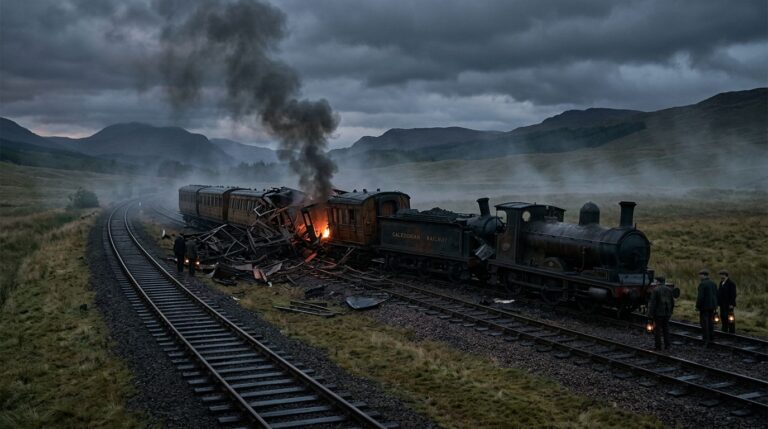
The forensic work led to Elmer McCurdy, an outlaw killed in Oklahoma in 1911. He was not a famous gunman in his own time. He was a small-time criminal, and his death came in a shootout, not in some grand final stand that made him a legend on the spot.
What changed everything came after his death.
McCurdy’s body was embalmed, and the embalming held. That preservation mattered because it kept his remains intact long after most bodies would have broken down. Instead of disappearing into the ground or a grave record, he remained visible, physical, and marketable.
An undertaker first displayed the corpse. From there, carnival operators took over. The body moved into a different economy, one built on curiosity, ticket sales, and the promise of seeing something strange. McCurdy stopped being known as a dead outlaw and became an attraction.
That turn is ugly, but it was simple. A preserved corpse drew attention. Once people saw that it could pull a crowd, it stopped being a body with a burial waiting. It became an object that changed hands.
The transcript of his afterlife is cleaner than the ethics behind it. McCurdy died in 1911. He was preserved with unusual success. An undertaker put him on display. Then showmen carried him into the carnival circuit. The broad line of the story is clear, and that line is enough to explain how a man ended up hanging in a Long Beach funhouse 65 years later.
America turned him into “the bandit who wouldn’t give up”
After that first display, McCurdy moved from show to show across America. Carnival operators billed him as “the bandit who wouldn’t give up.” It was a hard-selling phrase, the kind of line that fit midway barkers and roadside attractions. It also helped erase the fact that the exhibit was a person.
His remains were handled the way props are handled. Workers hung him from nooses. They propped him in corners. Visitors touched him, passed by him, and looked him over without suspecting they were close to an actual corpse.
That detail matters because it explains why the mistake lasted so long. Most people do not expect a real body in a funhouse. They expect theater. They expect cheap tricks. So the body kept winning the disguise.
The workers treated McCurdy the same way. He was moved between funhouses and sideshows as if he were no different from a rubber mask or a creaking mannequin. Over time, routine did the rest. A strange object becomes ordinary once enough people carry it, hang it up, and stop asking where it came from.
There is also a rough logic to the nickname. McCurdy had died in 1911, but his body kept turning up in public, year after year, city after city. In carnival terms, that was useful. In human terms, it was a long refusal of burial.
The story feels impossible at first because the line between prop and person seems too obvious to miss. Yet that line can disappear when a body is altered, preserved, mislabeled, and folded into a setting built on fakery.
The identification came down to records, not legend
Once the Long Beach discovery forced the issue, authorities could stop treating the figure as a curiosity and start treating it as evidence. The body had survived long enough, and in good enough condition, for investigators to work from the remains.
They identified McCurdy through fingerprints and dental records. That is the hinge of the whole case. Carnival stories had kept the body in motion, but official records pulled it back into documented history.
The main dates are easier to follow in one view:
| Year | What happened |
|---|---|
| 1911 | Elmer McCurdy died in a shootout in Oklahoma. |
| 1911 | His body was embalmed and displayed by an undertaker. |
| 1911 to 1976 | Carnival operators passed the body from show to show across America. |
| 1976 | A film crew in a Long Beach funhouse broke the arm and exposed human bone. |
| 1977 | McCurdy received a proper burial in Oklahoma. |
The timeline shows two separate lengths of time. The body had been displayed as a carnival attraction for about 65 years. Then, in 1977, McCurdy was buried 66 years after his death. Those numbers are close, but they are not the same, and the difference comes from the year between the discovery and the burial.
The identification also stripped away the carnival script. He was no longer a nameless mummy, no longer a spooky fixture with a sales pitch attached. He was Elmer McCurdy again.
He finally went back to Oklahoma
McCurdy received a proper burial in Oklahoma in 1977. That was the first real close to the story since the shootout in 1911.
There is no need to force extra meaning onto that moment. A body that had spent decades hanging in displays, crossing the country, and passing through countless hands was finally buried. The case moved out of carnival space and back into ordinary human terms.
What still makes the story hard to shake is not mystery in the usual sense. The facts are blunt. A preserved corpse entered the sideshow trade, stayed there for decades, and was only recognized when an accident broke the surface.
Some parts of that long trip are thin in the brief public outline. Still, the core record is clear. Elmer McCurdy died once, in 1911. His body kept traveling for 66 more years. Then, at last, it stopped.