
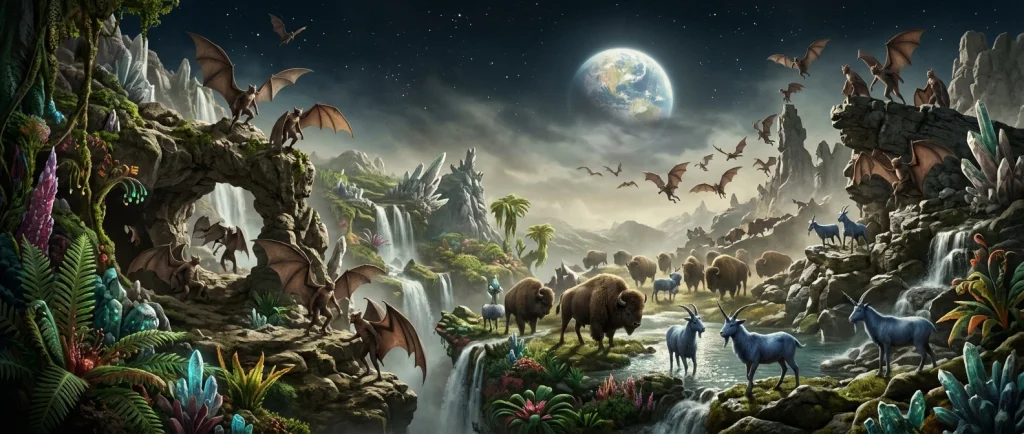
The great moon hoax of 1835 was a series of newspaper articles in the New York Sun claiming that astronomer Sir John Herschel had spotted bison, blue unicorn-like goats, and winged bat-men on the moon. Reporter Richard Adams Locke wrote it. Readers loved it, and the paper’s sales soared before the story fell apart.
The Great Moon Hoax of 1835
It was a run of six articles in the New York Sun, published in late August 1835, that described life on the moon as if a real scientist had just seen it through a giant telescope. The paper presented the whole thing as straight news, with no wink to the reader.
The first installment announced that Sir John Herschel, one of the most respected astronomers in the world, had made huge discoveries from an observatory in South Africa. Each day’s article then described a new part of the lunar landscape: craters, oceans, forests, and eventually animals and people.
Most retellings jump straight to the lizards and unicorns. The more interesting question is why it worked. Three things lined up: a very cheap paper, a very famous name, and readers who badly wanted to believe the sky held surprises.
Who was Richard Adams Locke, and why did he write it?
Richard Adams Locke was an English-born journalist working for the Sun in 1835, and he is generally credited as the author of the whole series. The paper never signed the articles, so for a while nobody outside the office knew who had written them.
Why he wrote it is less clear, and the answer depends on who is telling the story. Locke later said he meant it partly as satire. Writers of the day, including a popular Scottish author named Thomas Dick, had published confident speculation about people living on the moon and planets, often tying it to religion. Locke is said to have wanted to poke fun at that kind of overconfident reasoning.
The Sun’s owner had a simpler motive. The paper had launched only two years earlier, in 1833, and it lived or died on how many copies it sold on the street each morning. A story that made people rush to the newsstand every day for a week was good business, whatever Locke’s private joke was.
So the likeliest answer is both: a clever writer with a point to make, working for a paper that needed readers. Neither motive required the story to be taken seriously, and neither stopped the public from doing exactly that.
How did a made-up report from a famous astronomer sound so believable?
It sounded believable because Locke borrowed a real name, a real location, and real scientific language, and then buried his inventions in detail. The articles said they were reprinted from the Edinburgh Journal of Science, a genuine type of publication that few New Yorkers could look up.
Here is what he borrowed:
The pacing helped too. Locke did not open with bat-men. The early installments described the telescope and the moon’s plants and landscape, and the odd animals arrived only after readers had already accepted the setup.
Each article also ended with the reader wanting the next one. That is a good reason to buy the paper again tomorrow, and it is also a way of getting people to trust a source: by the fourth day, the Sun felt like the place where this discovery was being reported.
What did the Sun say was living on the moon?
According to the Sun, the moon held a surprising range of animals and at least two kinds of intelligent beings. The reports built up step by step, which made each new claim feel like a smaller leap than it was.
The creatures described included:
The landscape was just as colorful. The articles described red flowers, lunar forests, and a temple with a gleaming blue roof. The Sun even used a bit of caution in places, saying the observers could not be sure what some of the structures were, which made the writing feel more honest.
What stands out is how ordinary the tone was. The articles did not sound like an adventure tale. They read like a lab report that kept finding better and better things.
Why did so many people believe it?
Many people believed it because it came from a source they already bought, it matched their curiosity, and they had few ways to check it. The explanation is more about the readers’ situation than about their intelligence.
Here is what was going on in 1835:
- Penny papers were new. The Sun cost one cent, far less than the established New York papers, which were sold mainly by subscription. That put a daily paper in the hands of many people who had never regularly read one.
- People wanted wonder. Telescopes were improving, and astronomers really were finding new things in the sky. A discovery of life on the moon seemed like the next step, not an absurdity.
- Checking was hard. With no telegraph and no way to reach South Africa quickly, nobody could confirm the story. Readers had only the article and its claims.
- Nobody had the ability to compare sources fast. A story that appeared in one paper could take days to be tested elsewhere, and by then the next installment was out.
The result was a spike in sales. Copies were reportedly in short supply, and people gathered around the Sun’s office wanting the latest installment. Other newspapers began reprinting and discussing the articles, which spread the story further.
Not everyone bought it, of course. Some readers were skeptical from the start, and some enjoyed it without caring whether it was true. But enough people took it seriously that the story became a New York sensation.
How did the hoax fall apart, and did anyone get in trouble?
The hoax fell apart because rival newspapers started asking questions, the real author was identified, and the Sun eventually admitted the story was not factual. Nobody faced serious consequences, which says a lot about how newspapers worked at the time.
Rival papers were quick to challenge it. Some were suspicious, and some were simply irritated that the Sun was getting all the readers. One rival, the New York Herald, noticed that the writing sounded like Locke’s and pointed in his direction. Locke reportedly confessed to a colleague, and word got around.
The Sun did not make a dramatic apology. Within a few weeks it stated that the account was a hoax, and it moved on to the next sensation. The wording was low-key, and the paper kept the readers it had gained.
As for Herschel, he was reportedly amused by the whole thing, though he also found it a nuisance, as people wrote to him asking about it. There is no evidence he took any legal action.
Locke was not punished either. Journalism in the 1830s had few formal standards, and the line between a news story and an entertaining invention was blurry. There was even a side dispute: the writer Edgar Allan Poe, who had published his own moon-voyage tale shortly before, suggested that Locke had copied his idea.
What can a 190-year-old moon prank teach us about news today?
It teaches that people tend to trust a story more when it comes from a familiar source, uses a famous name, and sounds technical, and those same tricks still work. The moon hoax is a useful reminder that a convincing format is not proof.
A few habits from the story are worth keeping:
None of this means the readers of 1835 were foolish. They were doing what most people do, which is trusting a paper they bought and a scientist they had heard of. The lesson is not that people used to be gullible. It is that a good story told in a trusted voice is always more convincing than it deserves to be, and that has not changed in 190 years.
If you like stories where printed words fooled a whole town, read The Circleville Writer: Anonymous Letters Terrorized Ohio for 17 Years.