
The War of the Oaken Bucket: Italy’s Weirdest Fight
The War of the Oaken Bucket sounds more like a prank than real history. A wooden bucket, a medieval rivalry, and thousands of soldiers do not seem like ingredients for a serious war.
But the story is based on a real conflict between the Italian cities of Modena and Bologna. The important detail is that the bucket probably did not start the war. It became famous after Modena defeated Bologna in battle and reportedly took the bucket as a trophy.
Over time, the object became a symbol of the conflict. Later writers turned the strange episode into one of Italy’s most memorable historical stories.
Medieval Italy’s Divided Cities
Medieval Italy was not a unified country. It was divided among independent communes, city-states, lordships, and territories controlled by powerful families. Many cities had their own governments, armies, laws, and political interests.
These cities often competed for land, trade routes, castles, and regional influence. Neighboring powers could be partners one year and enemies the next. A dispute over a border or fortress could quickly become a larger military crisis.
Modena and Bologna were longtime rivals in northern Italy. Their conflict was made worse by the political division between the Guelphs and the Ghibellines.
The Guelphs generally supported the pope. The Ghibellines generally supported the Holy Roman Emperor. The division was not always simple, and local politics often mattered more than ideology, but the rivalry still shaped alliances across medieval Italy. Factional politics could also turn bizarre: in one infamous Roman episode, a church court put a dead pope on trial.
Bologna was a leading Guelph city. Modena was more closely connected with the Ghibelline side. Their political differences added another layer of tension to existing disputes over territory and power.
The Real Causes of the Conflict
The War of the Oaken Bucket was not simply a reaction to a stolen household object. Modena and Bologna had been competing for years before the famous bucket entered the story.
Their disagreements involved local borders, castles, political influence, and control over nearby territory. Each city wanted to protect its interests and avoid looking weak to its rivals.
The Guelph and Ghibelline divide also affected the conflict. Bologna had strong ties to the papacy, while Modena was connected to leaders who supported the emperor. That meant a local dispute could carry wider political consequences.
By 1325, the rivalry had reached a dangerous point. The two cities prepared for open conflict, and their armies eventually met near the village of Zappolino.
The Battle of Zappolino
The decisive battle took place on November 15, 1325, near Zappolino, in the area between Bologna and Modena.
Later accounts give different figures for the size of the two armies. Some claim that Bologna brought more than 30,000 men, while Modena had only around 7,000. These numbers may be exaggerated, as medieval chroniclers often reported large figures to make a victory or defeat seem more dramatic.
Even with that warning, the basic story is clear. Bologna had a larger force, but Modena won a major victory.
The Modenese army defeated the Bolognese forces and sent them into retreat. Some accounts say that about 2,000 men died, although the exact number is uncertain. Many soldiers were also wounded, captured, or forced to abandon their weapons.
The defeat was a serious blow to Bologna. It also gave Modena a victory that the city could celebrate for generations.
How the Bucket Entered the Story
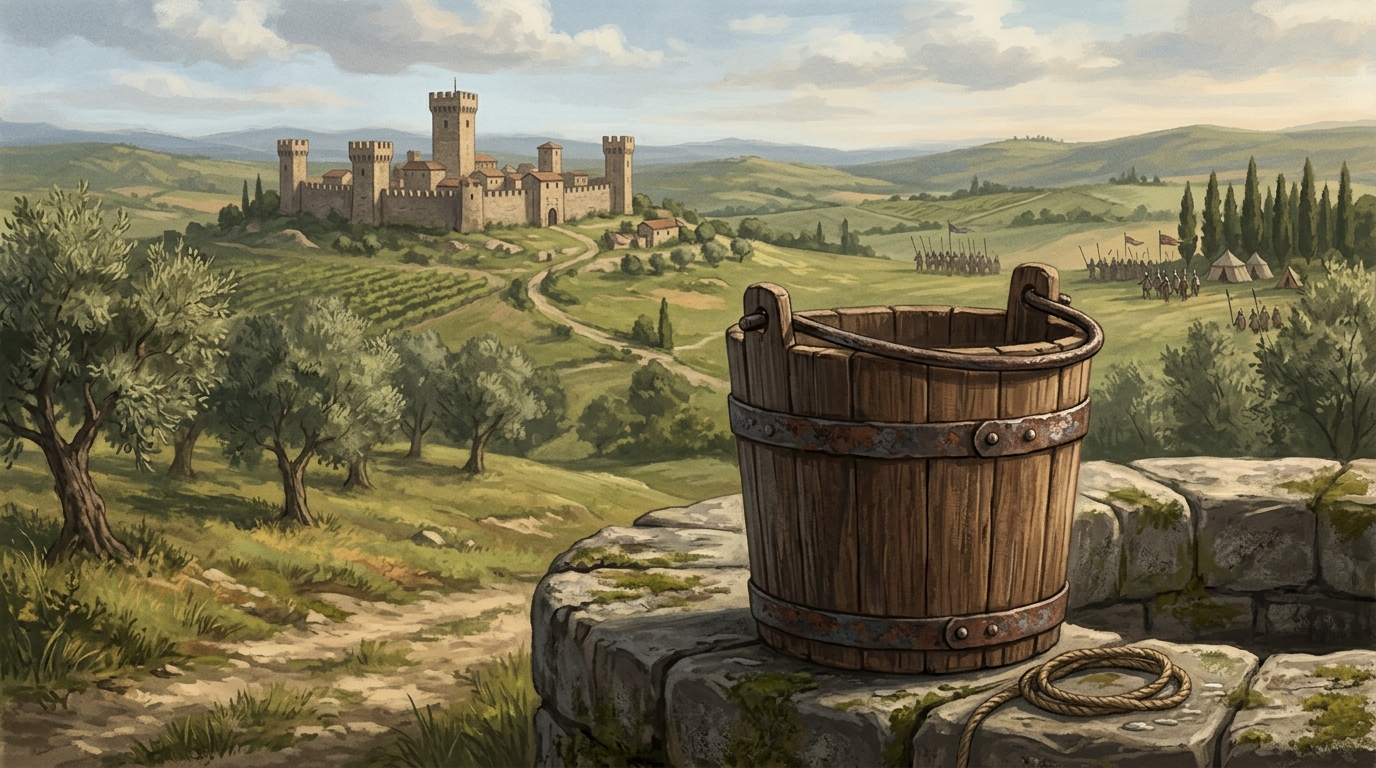
According to the traditional account, Modenese soldiers later took a wooden bucket from a public well in Bologna. They carried it back to Modena as a trophy.
The bucket had little material value. It was an ordinary object used for drawing water. Its importance came from what it represented.
For Modena, the bucket became a symbol of victory. It showed that the smaller city had defeated its powerful rival and carried away something belonging to Bologna.
For Bologna, the object represented humiliation. A military defeat was one thing. Having a common household bucket turned into a public trophy made the loss even more embarrassing.
The story is often told as if Modena stole the bucket first and Bologna went to war to get it back. That version makes for a better joke, but it reverses the likely order of events.
The bucket appears to have become part of the story after the Battle of Zappolino. The war itself grew from years of political and territorial tension.
Why a Bucket Became So Important
The bucket mattered because medieval politics placed great value on honor and reputation.
A city could not easily ignore a public insult. Leaders had to show strength to their own citizens and to rival powers. If they appeared weak, other enemies might decide to test them.
That made symbols powerful. A castle, flag, weapon, or bucket could represent much more than its practical purpose. Once the bucket became connected to Modena’s victory, returning it would have meant giving up part of the story.
Keeping it allowed Modena to preserve the memory of its success. Displaying it reminded people that Bologna had suffered a humiliating defeat.
In that sense, the bucket was not the real cause of the conflict. It was a symbol of everything the conflict represented: rivalry, political pride, military success, and public humiliation.
What Happened After the Battle?
Modena’s victory did not end all tension between the two cities. The conflict continued through politics, negotiations, and shifting alliances.
Still, the Battle of Zappolino became the event most closely associated with the war. The bucket gave the story a memorable detail that ordinary accounts of medieval politics often lack.
Modena preserved the object as a civic trophy. According to Modena’s heritage authorities, the original bucket is kept in the city’s Town Hall. A copy is displayed in the Hall of the Stolen Bucket inside the Ghirlandina, Modena’s famous cathedral bell tower.
The object itself is simple. It is not a jewel-encrusted royal treasure. It is a plain wooden bucket with metal bands.
That contrast is part of the story’s appeal. An ordinary object became connected to a major battle and a long-running rivalry between two important Italian cities.
Tassoni and The Stolen Bucket
The bucket’s reputation grew much later through literature.
In 1622, the Modenese poet Alessandro Tassoni published La secchia rapita, usually translated as The Stolen Bucket. The poem retold the conflict as a mock-heroic epic.
Tassoni treated the subject with humor. He used the grand style of traditional epic poetry to describe a dispute involving a common wooden bucket. The contrast made the story even more entertaining.
The poem helped preserve the bucket war in Italy’s cultural memory. Without Tassoni’s work, the conflict might be remembered mainly as a regional medieval battle. Instead, it became a story with a built-in punchline.
The poem also helped strengthen the idea that the war was fought over the bucket, even though the actual conflict had deeper political and territorial causes.
The War’s Strange Legacy
The War of the Oaken Bucket survives because it combines serious history with an absurd detail.
The conflict involved armies, political alliances, territorial disputes, and thousands of people. Those details fit the pattern of many medieval wars.
The bucket does not.
That is why people remember it. A normal account of a battle between rival Italian cities might disappear into a history book. A battle connected to a stolen wooden bucket is much harder to forget.
The story also shows how historical memory changes over time. The original participants may have viewed the event as a serious struggle over power and territory. Later generations could focus on the strange trophy and turn the whole episode into a joke.
Alessandro Tassoni’s poem played an important role in that transformation. It helped turn a regional conflict into a story about pride, humiliation, and the ridiculous side of war.
What the Conflict Tells Us About Medieval Life
The story offers a useful lesson about medieval politics. Wars rarely begin for only one reason.
A dispute that appears small may sit on top of years of anger, competition, and mistrust. The visible incident is often only the final trigger.
In this case, the important causes included:
- Rivalry between Bologna and Modena
- Disputes over nearby territory
- Competition for political influence
- The wider Guelph and Ghibelline conflict
- The need for city leaders to protect their reputations
The bucket became famous because it gave the conflict a simple explanation. It turned a complicated political struggle into a story anyone could understand.
That simple explanation is entertaining, but it is not the whole history.
Why the Story Still Works
The War of the Oaken Bucket remains popular because it connects serious events to something familiar.
Most people understand why a city might fight over land or power. Those causes are common throughout history. But a bucket feels different. It is ordinary, cheap, and easy to imagine.
That makes the story feel almost modern. People still argue over symbols, public insults, sports trophies, flags, and objects that represent a larger issue.
The bucket was never important because of its price. It became important because both sides attached meaning to it.
For Modena, it represented victory. For Bologna, it represented defeat. For later generations, it became a reminder of how pride and rivalry can turn a small symbol into something much larger.
Seeing the Bucket Today
Visitors to Modena can explore the city’s historic center and learn about the bucket through local heritage displays. A copy of the famous object is displayed in the Ghirlandina, while the original is kept in the Town Hall.
The bucket may look ordinary, but its history is not. It represents a battle, a political rivalry, a literary satire, and centuries of local memory.
Its survival also shows how cities choose to remember the past. Modena can present the object as a sign of cleverness and victory. Bologna can treat the episode with humor and distance. The original bitterness has faded, leaving behind a strange shared story.
Final Thoughts
The War of the Oaken Bucket was not really a war caused by a bucket. It was a conflict shaped by territorial disputes, political alliances, military rivalry, and the struggle for local power.
The bucket became important later because it gave the story a clear symbol. A plain wooden pail came to represent a city’s victory and another city’s humiliation.
That is why the story has lasted for so long. It reminds us that history is not always remembered for its most important facts. Sometimes, a complicated conflict becomes famous because of one strange object.
In this case, that object was a wooden bucket.