

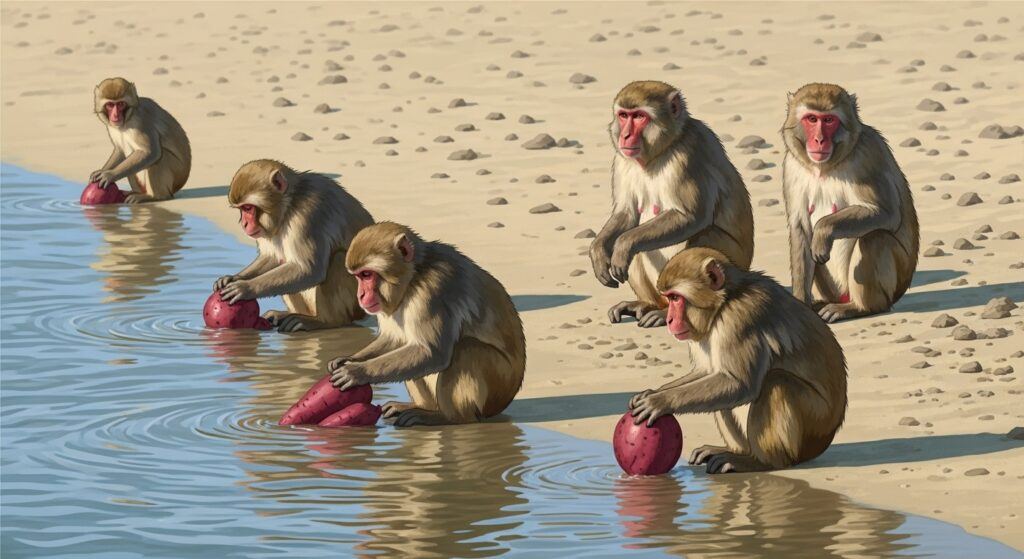
The 100th monkey effect comes up a lot when people talk about social change or group learning, but most people don’t realize how murky the actual evidence is. The original story comes from a series of studies on Japanese macaques in the 1950s, in which researchers noticed young monkeys washing sweet potatoes and then saw the practice spread to others. Some people later claimed that when enough monkeys learned the behavior, the knowledge suddenly jumped to monkeys on other islands. This claim has been debated ever since.
The Origins: Where the Story Comes From
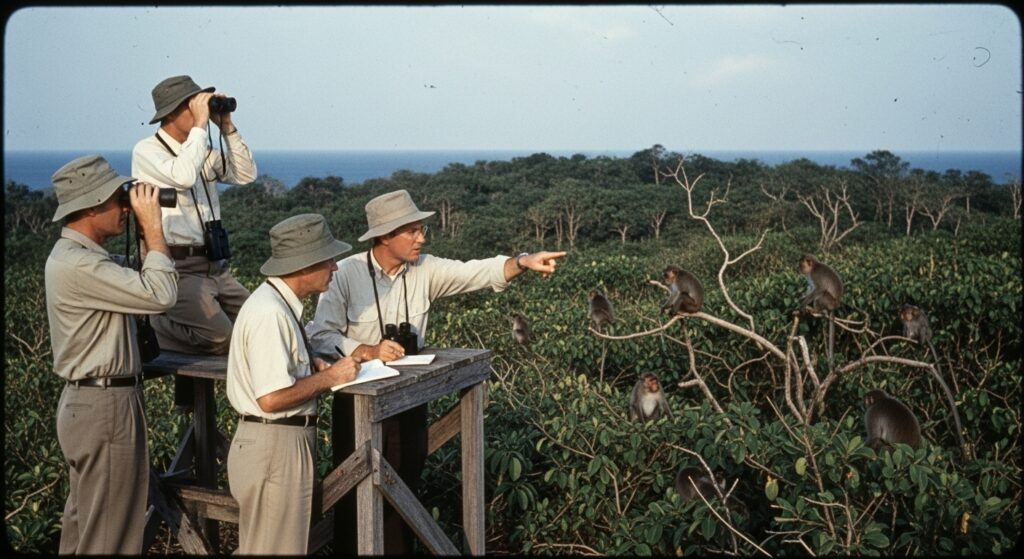
The 100th monkey effect dates back to research by Japanese primatologists on Koshima Island in the early 1950s. Scientists, including Kinji Imanishi and his team, were studying Japanese macaques and their responses to new foods. They started dropping sweet potatoes on the beaches and watched what happened next.
According to published studies, a young female monkey (Imo) was observed washing sandy potatoes in water before eating. Within a few years, her playmates and mother picked up the washing. The practice was then slowly adopted by more monkeys, especially the young ones. These observations were carefully recorded over time and can be found in several academic articles and field notes from the era.
Decades later, the story took on a life of its own. Lyall Watson, an author and biologist, described an event in his 1979 book as if there was a magical tipping point; once the 100th monkey learned the washing trick, the entire troop, and even monkeys on other islands, supposedly picked it up instantly. Watson’s version caught the public’s imagination. But there’s no peer-reviewed study that backs up the sudden, mass learning leap described in the book.
What the Research Really Shows
If you stick to the scientific record, the spread of sweet potato washing was gradual. Peer-reviewed articles by the original researchers (such as those by Imanishi and Kawamura in Primates) describe a typical process of social learning. Young monkeys learned by watching others, and some older monkeys eventually picked up the habit too, but not all did. The behavior didn’t leap to other troops instantly or magically cross the sea to other islands.
It’s important to note: the spread never involved every single monkey, not even on the original island. While traditions did appear in isolated monkey groups later, researchers agree they could have developed through regular observation, contact during troop interactions, or entirely independent learning. There’s no credible documentation of an abrupt, group-wide switch tied to a precise number, let alone “100.”
How the 100th Monkey Effect Became a Meme
While the scientific record is straightforward, the idea of the 100th monkey effect got picked up by plenty of writers, speakers, and even New Age thinkers. Part of the reason is how catchy the story sounds; there’s a moment when change feels slow, then suddenly everyone “knows” at once. People pointed to this as proof that big social changes could happen quickly once enough people understood something, but that claim has never been demonstrated in animals or humans with verified data.
Watson himself admitted he embellished the story and had lost his original sources. Multiple investigations by science writers in the years since (see Behavioral and Brain Sciences and the analysis in The Skeptical Inquirer). As far as the documentation goes, what actually happened on Koshima was ordinary, face-to-face social learning seen in many animal species.
Understanding Social Learning in Animals
If you’re interested in how animals learn from each other, the field of animal culture offers some solid examples. Researchers have observed traits such as tool use in chimpanzees and song learning in birds spreading through populations over time. But every documented case has involved direct observation, imitation, or a long process of trial and error, not sudden, mass adoption sparked by hitting a magic number of adopters.
Some scientists have explored the mathematics of social tipping points, such as through network theory, and while the idea that behaviors can spread faster after a certain threshold is crossed is real, it’s nothing like the “100th monkey” leap described in the legend. Even these models are based on gradual processes that depend on real social interactions and communication, not something mysterious or instant.
This isn’t to say that group dynamics and threshold effects don’t exist in nature or society. Often, when a behavior reaches a certain level of visibility, its spread may accelerate through social reinforcement, but it still relies on observable contact and communication. For instance, studies of cultural traditions in wild chimpanzees have shown that young chimpanzees gradually acquire tool use and foraging skills, often from siblings or mothers. Birds learning new songs sometimes copy mistakes from the most influential singers, leading to shifts across communities—but everything traces back to direct exposure, not unexplained jumps.
Common Questions About the 100th Monkey Effect
Here are a few of the questions I’ve run into whenever I’ve talked about this topic with others or taught animal behavior classes over the years:
Frequently Asked Questions About the 100th Monkey Effect
Is there any proof that ideas or skills can leap between groups without direct contact?
So far, peer-reviewed science has not shown any process where ideas or skills transfer between animal or human groups without direct contact. Known explanations include migration, communication, shared environments, or coincidence. Claims involving group telepathy or psychic transfer have not appeared in credible scientific studies.
Did the sweet potato washing actually spread to other islands?
Yes, similar behaviors appeared on other islands, but always in ways that can be explained by normal social learning or rare contact events. Monkeys sometimes move between islands, and humans have also introduced animals to new locations. No documented case has shown a completely unexplained leap in behavior.
Are there examples of rapid cultural change in wild animals?
Yes, some behaviors can spread quickly if they are useful and younger animals are eager to imitate. However, every known example has a clear explanation based on observation and practice. No sudden group-wide insight without learning or exposure has been documented in the wild.
Has human behavior ever demonstrated a real tipping point effect?
Sometimes human ideas, products, or movements grow slowly and then rapidly increase in popularity. These moments are typically explained through communication networks, peer influence, exposure, and prior groundwork. There is always evidence of transmission and influence rather than a mysterious jump tied to a specific number of people.
Important Considerations Before Accepting Viral Animal Behavior Claims
Stories like the 100th monkey effect show how easy it is for a simple observation to get stretched into something bigger. Here are some things to keep in mind when you run into similar claims:
- Always check whether the original research aligns with the dramatic story. The actual field studies were much slower and more ordinary than the legend.
- Be skeptical of stories that go straight to big group-level change without intermediate steps. Scientists want to see evidence of the process, not just a before-and-after.
- Different animal species learn differently. What works for macaques may look very different from what’s true for birds, dolphins, or humans.
Lack of Peer-Reviewed Evidence
If the only references you can find are from books outside the scientific literature or personal testimony, be cautious. For the 100th monkey effect, all peer-reviewed work points to standard social learning, nothing sudden or mysterious.
The Problem with Magic Numbers
No academic publication supports the idea that there’s a specific, meaningful number that triggers mass learning or adoption, whether 100 or anything else. The use of “100” in the story is arbitrary and unsupported by actual observation.
The Power of Repeated Storytelling
When a story is told enough times, people start believing it, even if the evidence isn’t there. This happens with urban legends, and it happened here.
None of this means that group learning or social tipping points aren’t worth studying. Animal cultures are real, and many researchers focus on how new behaviors take hold. It’s just important to keep the conversation centered on what’s been actually documented and avoid the urge to believe in sudden, unexplained leaps just because the story is more exciting that way.
Real-World Applications: Why Does This Story Matter?
The 100th monkey effect pops up all the time in books and motivational speeches, usually as an example of rapid change. Some writers use it to encourage activism or to justify continued work toward progress, under the theory that a breakthrough could spark mass change at any moment. While it’s always great to keep pushing for good ideas to catch on, the monkey story doesn’t really support that lesson in a scientific way.
If you want examples of rapid spread in real human society, check out things like technology adoption or viral social media trends. Even there, the change is usually traceable through communication networks, advertising, personal experience, and other known processes. It’s a good reminder that stories about the natural world should be carefully checked before using them as metaphors in other fields. Historical examples ranging from the growth of the internet to popular dance challenges show that viral trends always leave evidence of transmission—there’s no mystical leap.
Looking closer, the way information spreads among people continues to fascinate researchers. Social networks, influencers, and the desire to emulate can all make trends go mainstream rapidly. Still, every step gets tracked and mapped, proving that sudden global changes have down-to-earth roots. The monkey tale sounds appealing, but the actual story behind change is usually a bit more complex and rewarding to understand.
Limits of Our Understanding
Despite all the studies and debates, the real process by which new cultural behaviors emerge and spread, both in animals and in people, remains full of questions. Researchers keep tracking changes in wild animal populations, tracing how traditions grow or fade, and looking for cases where something truly unusual happens. So far, the evidence sticks to what’s been observed: learning is social, shared face-to-face, and subject to all the quirks of animal life.
The story of the 100th monkey reminds me to always ask: what’s been actually observed, and what’s just a catchy story? For now, careful research beats wishful thinking every time. Staying skeptical and checking sources helps keep us grounded—whether the topic is primate traditions or viral human behavior.