
Yale holds plenty of famous texts, but one volume sits apart because it still won’t speak. The Voynich Manuscript (often described as a 15th-century codex) has resisted every serious attempt to read it, from traditional cryptography to modern computing. What makes it worse is that it doesn’t look like a random hoax. The writing behaves like language, the pages are packed with drawings, and none of it lines up cleanly with anything else we know.
Hidden in Yale’s Rare Book Library
Deep inside Yale University’s rare book library, the Voynich Manuscript sits like a sealed container. It’s physically present, carefully stored, and publicly known, yet it stays out of reach in the one way that matters: nobody can confidently say what the text means.
That setting adds pressure. Libraries are built for access, for reading, for proof. This one book flips that expectation. Researchers can study the ink, the script, the illustrations, the layout, and the wear. Still, the central task, translating a line, stays undone.
A simple photo of Yale’s Beinecke Library exterior fits well here, because the building’s clean geometry matches the manuscript’s stubborn silence.
A document that baffles history
This manuscript has been a long-running problem, not a short-lived curiosity. Experts have worked on it for more than a century, and the score hasn’t changed. The pages keep their meaning, and the field keeps its questions.
The manuscript’s basic facts, and why they matter
Some things about the Voynich Manuscript sit on firmer ground than its meaning. The book is commonly described as 240 pages of dense writing and full-page illustrations. Page after page uses the same unknown characters, arranged with a steady hand, as if the writer followed rules.
The dating also places it where the mystery gets uncomfortable. Scientific testing has tied the manuscript to the 15th century, which puts it in the late medieval period. That matters because it removes easy answers. It’s not modern performance art. It isn’t a recent prank built to look old. Whatever it is, it comes from a world that did not leave behind a clear key.
In other words, the manuscript’s age and consistency force a basic conclusion: it was produced with intent, time, and skill, even if the purpose stays unclear.
240 pages of secrets
The sheer volume is part of the trap. A short cipher can be a stunt. A long, uniform text takes stamina, materials, and planning.
Carbon dated to the 15th century
Carbon dating places the manuscript in the medieval period. That single fact keeps pulling scholars back, because it suggests the puzzle has been sitting in plain sight for centuries.
The puzzle of the unknown script
At the center sits the writing itself. The Voynich Manuscript is written in an unknown script, line after line, with characters that don’t map cleanly onto familiar alphabets. The text looks fluent. It doesn’t feel like someone randomly stamping symbols. Spacing and repetition appear controlled, like the writer knew what a “word” was in their system.
That look of fluency creates two competing pressures. On one hand, a consistent script hints at a real language or a real code. On the other hand, the lack of a breakthrough after so much effort hints at something stranger: either the key is missing, or the system was never meant to be read by outsiders.
Either way, the manuscript blocks the usual entry points. There’s no confirmed starting phrase. There’s no bilingual reference. There’s no agreed-upon alphabet. That’s a hard place to begin.
No decodings in over 100 years
Linguists and cryptographers have taken their shot, again and again. Still, no one has produced a translation that stands up to serious review. The blunt summary stays the same: nobody has decoded a single word in a way the wider field accepts.
Efforts spanning generations
- Countless attempts came from many camps, from language specialists to code-breakers.
- Many methods were tried, including pattern study and cryptographic approaches.
- Zero consensus emerged, and that’s the problem that won’t go away.
The illustrations don’t play nice either
If the text were the only issue, the drawings might offer a side door. Instead, the images add their own locks. The manuscript includes detailed illustrations that look purposeful, yet they refuse to settle into a stable interpretation.
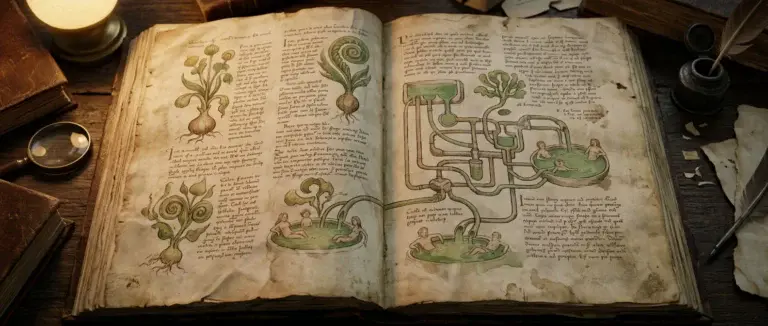
Some pages show plant-like forms, drawn with care, as if the illustrator wanted accuracy. Other pages shift toward diagrams that feel technical, almost instructional. Then the tone changes again, with human figures in scenes that read like ritual or procedure. The mix suggests structure, not doodling, but the structure stays out of focus.
A good spot for an image here is a public-domain-style scan of one page, because even a quick glance shows how confident the pen work is.
Plants that don’t exist
The manuscript’s botanical drawings look detailed, but they don’t match known plants in any clean way. Leaves, roots, and stems appear arranged with a naturalist’s attention, yet the overall forms don’t line up with established species.
That mismatch matters because it breaks an easy explanation. If the plants were recognizable, researchers could build vocabulary from them. Instead, the drawings sit in a gray zone: realistic style, uncertain subject.
Why these drawings confuse experts
The art suggests observation. The subjects resist identification. That gap keeps the botanical section from becoming a translation tool.
Astronomical diagrams
Other pages carry astronomical-style diagrams, with circles, radiating lines, and structured layouts that feel like charts. The manuscript hints at the sky, timekeeping, or cosmology, but it does so in a visual language that doesn’t match standard medieval systems.
The result is familiar and foreign at the same time. The shapes suggest organized knowledge. The symbols refuse to anchor to known traditions.
Symbols matching no known system
- The diagrams use unfamiliar symbols instead of standard markers.
- The configurations don’t cleanly match known chart traditions.
- The overall system stays unmapped, even when compared against historical references.
Strange bathing scenes
Then come the bathing scenes, which shift the whole mood. The manuscript shows naked women in clustered, staged setups, often set in tub-like shapes or connected pools. The scenes feel procedural, like an illustrated sequence, but the purpose stays uncertain.
The figures don’t read like casual nudity in art. The layouts look organized, almost instructional. That’s why these pages draw so much attention. They imply context, but they don’t supply it.
Bizarre ritualistic poses
Some figures appear placed in poses that look ritualistic, not expressive. The sense of ceremony comes from repetition and arrangement, not from any confirmed story on the page.
What science says about the text
Modern analysis didn’t translate the Voynich Manuscript, but it changed the argument. Computer-based study of the text suggests it follows genuine linguistic patterns. That doesn’t mean anyone knows the language. It means the writing behaves less like noise and more like structured communication.
Researchers can test distribution, repetition, and ordering without knowing meaning. Those tests can’t tell you what a word means, but they can show whether a system acts like language. By that standard, the Voynich text looks organized.
That finding cuts both ways. It reduces the odds of pure nonsense. At the same time, it raises the stakes, because now the question becomes sharper: if it’s structured, why can’t anyone read it?
Computer analysis findings
Computers can scan for patterns a person might miss, especially across hundreds of pages. Those studies found repeated shapes and consistent arrangements that resemble how real languages distribute words.
Not meaningless symbols
The key point is simple: the text shows signals of structure. That supports the idea of a real language or a real encoding system, not random marks.
Natural flow in the writing
The writing also looks steady on the page. Lines run with consistent spacing and rhythm. Repeated forms appear in ways that resemble grammar more than decoration.
Grammar-like structures revealed
Pattern alone doesn’t equal meaning, but it can show discipline. The Voynich Manuscript shows grammar-like structures, including repeated word patterns and regular-looking sequences. In many languages, certain words cluster, some appear frequently, and others stay rare. The manuscript seems to show a similar spread.
That’s why the book keeps its grip on researchers. A chaotic hoax tends to wobble under analysis. This one holds a shape. It looks like somebody built it to work.
The hard part is that structure can prove intent, but it can’t deliver translation on its own.
Consistent patterns like real languages
The text repeats in ways that feel systematic, as if the author followed rules across the whole manuscript rather than improvising page by page.
Repeated word patterns
- The repetitions mirror authentic languages, where common terms cycle often.
- The repeated forms suggest purpose, because they appear in consistent contexts.
Evidence of genuine language
Taken together, the patterns don’t solve the manuscript. They do support a grounded claim: the writing system is complex enough to imitate language well, or it is language in a form we still can’t place.
AI enters the mystery, and it doesn’t win
Artificial intelligence brought a new round of attention. The promise was obvious. If any tool could spot hidden structure, it would be a machine trained to chew through patterns.
Those studies confirmed what earlier computer work suggested: the text has linguistic complexity. Yet the same studies also hit the same wall. AI can measure structure. It can compare forms. It can cluster patterns. Still, it can’t reliably map the script to meaning or identify a clear origin.
In other words, AI didn’t solve it. It mostly tightened the description of the problem.
Algorithms confirm complexity
Advanced algorithms found signals consistent with structured language. The manuscript continues to look “real” at the pattern level, even when tested with modern tools.
Deepened the enigma
The more tools confirm structure, the less satisfying the lack of meaning becomes. The manuscript keeps passing tests that random text shouldn’t.
AI’s big failure
The headline stays blunt. Modern systems still can’t crack the meaning or pin down the manuscript’s origin in a way that experts agree on.
Six centuries of silence, one stubborn codex
The timeline is part of the story. Carbon dating ties the book to the 15th century. That places it roughly six centuries behind the present, and it still hasn’t given up its message.
A “codex” is simply a bound book made of pages, not a scroll. That format usually helps survival and study. Here, it also helps the mystery last. The Voynich Manuscript sits intact enough to examine, but closed enough to frustrate.
After six centuries, it continues to guard its secrets.
Still guarding its secrets
Time didn’t soften the puzzle. If anything, time hardened it, because each failed attempt adds weight to the silence.
An impenetrable medieval codex
The manuscript remains one of the world’s most difficult texts to interpret. That status comes from a simple fact: it exists, it’s structured, and it won’t translate.
The lasting enigma
The Voynich Manuscript doesn’t need wild theories to feel unsettling. The known facts already do the job. It’s a medieval book, physically real, text-heavy, and stable enough for modern analysis. Still, it won’t yield a readable sentence.
That leaves the ending where it started: with a book that looks like language and acts like language, but stays unread. If new tools arrive, they’ll face the same test. Can they turn structure into meaning?
For now, the mystery holds. The silence is the point.