
Sealed Archives and Secrets Within
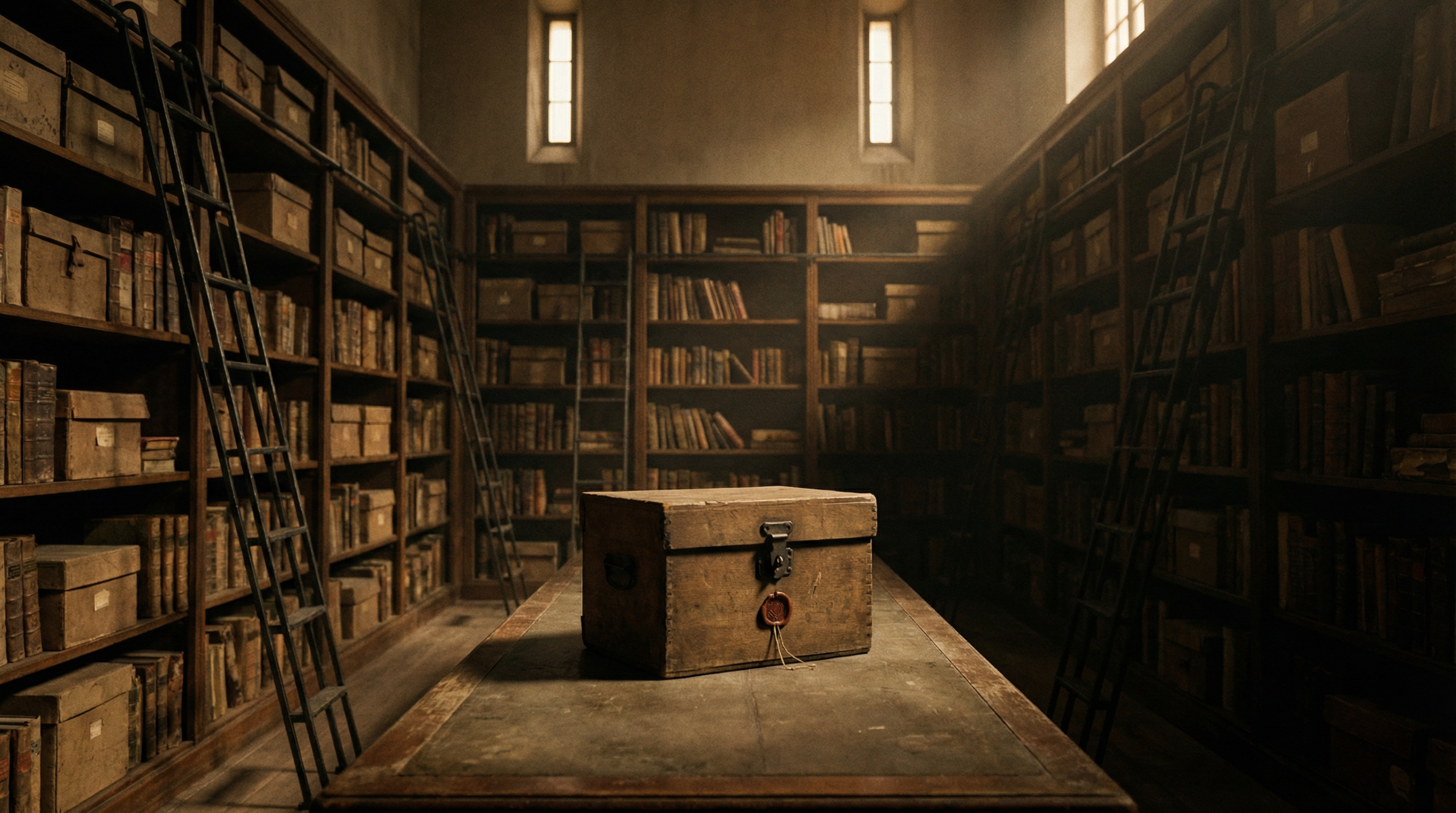
A sealed door in an archive isn’t a metaphor. It can be a real lock on a real box, backed by a court order, a donor contract, or a national security rule. For historians and journalists, sealed archives sit in an awkward space; everyone knows they exist, but no one can read them yet.
Some closures are sensible. Others feel maddening, because the public story has gaps that the records might fill. Still, the honest answer is often simple: the material is closed because living people could be harmed, or because governments and institutions don’t want sensitive details released on a calendar set by curiosity.
What “sealed archives” actually are (and why they stay closed)
In plain terms, sealed archives are collections kept from public access for a fixed period or until certain conditions are met. That can look like a box with a release date, a set of recordings under a court seal, or a file series that can’t be requested even if you know the title.
A useful way to think about it is that “sealed” isn’t always the same as “classified,” and it’s not always permanent.
| Type of restricted record | Who controls access | Common reason for closure | How it usually opens |
|---|---|---|---|
| Sealed personal papers | Donor, estate, library | Privacy, reputation, legal agreements | Release date or permission from the estate |
| Court-sealed materials | Courts | Trial fairness, privacy, and evidentiary rules | Judge’s order or time-based release |
| National security records | Government agencies | Sources, methods, ongoing risks | Declassification review (often slow) |
| Sensitive institutional records | Church, universities, and employers | Confidential processes, sensitive history | Case-by-case permission, sometimes partial access |
Why do institutions accept these terms at all? Because without them, some collections wouldn’t be donated. A former judge or politician might only hand over papers if there’s a cooling-off period. Families may agree to donate diaries or letters only if names stay protected for decades. Security services may share some records with official archives while keeping the most sensitive parts locked away.
There’s also a practical truth: archives contain messy human lives. Medical information, sexual relationships, financial disputes, and unproven allegations show up in primary sources. A seal can be a blunt tool, but it’s often used to reduce harm when redaction would be expensive or incomplete.
If you want an orientation to the variety of these closures, the public list of sealed archives offers a starting point (it’s not exhaustive, but it’s helpful for seeing patterns).
Sealed archives that remain unopened as of January 2026
Some sealed collections are discussed as if they must contain a single “secret.” Real archives are rarely that tidy. Still, a few closures matter because they sit close to power, and because the records could sharpen the historical record.
Warren Burger’s papers (sealed until 2026, still closed as of January 2026)
Former US Chief Justice Warren Burger’s letters are listed as sealed until 2026 at the College of William and Mary. As of January 2026, there has been no widely reported opening of these materials in the sources checked through the current sealed-archive summaries.
What might be inside? The responsible answer is that we don’t know, and we shouldn’t pretend we do. What we can say is why such papers are sealed: they may include frank opinions about colleagues, internal court culture, and private communications involving living relatives or people who never expected their names to become searchable.
If they open later in 2026, the value may be less about scandal and more about texture, how decisions were discussed, what was left out of public statements, and what day-to-day pressures looked like.
FBI surveillance tapes of Martin Luther King Jr. (sealed until 2027)
Another well-known example is the FBI’s surveillance recordings related to Martin Luther King Jr., which are listed as sealed until 2027. That date matters because it sits at the intersection of privacy, historical accountability, and the long afterlife of state surveillance.
The recordings and related materials are also ethically charged. Even when a public figure is involved, surveillance can capture private people who never chose to be part of history. Releasing raw material without care can cause real harm, even decades later. That tension is one reason sealed archives can persist long after the people who created them are gone.
The key point for readers is simple: a seal doesn’t automatically signal a cover-up. Sometimes it signals an unresolved conflict between the public’s right to know and private individuals’ right not to be dragged into a story they didn’t write.
“Box 24” and other long-closure files with far-off release dates
Some records are sealed with release dates so distant they function like a wall. The sealed-archive summaries list “Box 24” related to the abdication of Edward VIII, held at the Bodleian Library, with a release date in 2037. Other files in similar lists carry dates into the 2040s.
These cases are a reminder that “unopened” isn’t always a mystery in the romantic sense. It can be administrative timekeeping, influenced by institutional policy and legal agreements. The closure can also reflect reputational risk, because some documents don’t just change what we know, they change who looks good, and who doesn’t.
“Secret archives” that are more about controlled access than a single seal
Some repositories are described as “secret” even when they’re better understood as heavily managed. A common example is the Vatican’s central historical archive, which has long been surrounded by rumor. The reality is more procedural: access rules, credential checks, and catalog limits shape what researchers can see at any given time. A readable overview is History’s look at the Vatican’s archive, which focuses on scale and access rather than conspiracy.
It’s a good caution: sometimes the barrier isn’t a single locked box; it’s the slow grind of permissions, finding aids, and which years are open.
What researchers can do while records stay sealed
Closed doesn’t always mean silent. In the last decade, historians, conservators, and imaging specialists have gotten better at learning from materials while respecting restrictions and preservation needs.
One example is the study of “letterlocking,” the physical methods people used to fold and seal paper to prevent tampering. This isn’t just trivia. It changes how scholars read old correspondence, because the fold pattern can signal urgency, secrecy, or social rank. The BBC’s report on historical letterlocking techniques shows how much information can sit in the object itself, even before the words are read.
There’s also a careful line between opening and “reading.” A team working on 17th-century sealed letters demonstrated methods for extracting text without breaking the original folds. Utrecht University summarizes this approach in its report on sealed letters read without opening. The method doesn’t magically solve every case, but it shows a broader point: ethical research often means reducing damage, not forcing access.
And sometimes the simplest thing happens: the seal expires, the archive opens, and the story becomes more human than mythic. CNN covered a case where a cache of letters was finally opened after centuries, in its report on sealed French letters. The result wasn’t a single explosive revelation; it was a clearer view of ordinary lives caught in war and bureaucracy.
A recent reminder of how access can change quickly is the release of newly organized archival material around the Tutankhamun excavation, reported by the BBC in a 2025 piece on newly accessible Oxford archives. It’s not about sealed state secrets, but it shows how “closed” can shift to “available” once institutions finish the work and choose to open the doors.
Conclusion
Sealed archives don’t just frustrate curiosity; they mark where privacy, power, and history collide. Some will open on schedule, others may stay closed longer than promised, and a few may never be fully accessible. The healthiest way to follow these stories is to treat the seal itself as evidence of a boundary, not proof of what lies behind it. If more collections open in 2026 and beyond, the real payoff will be context, the kind that turns rumors into something we can actually verify.