

Most of us expect coins to carry big, solemn messages, liberty, unity, faith. So it can feel almost wrong to learn that early American money once carried a blunt line: “Mind Your Business.” Not as a joke, and not as a modern meme, but as a serious statement stamped into copper.
The phrase shows up most famously on the 1787 Fugio cent, an early federal-era coin tied to Benjamin Franklin’s design ideas. It’s also linked to an earlier 1776 “Continental Dollar” design that circulated in limited forms and exists today in several varieties. The story is real, but the details get slippery fast, especially online.
The “Mind Your Business” motto, what it meant in 1787
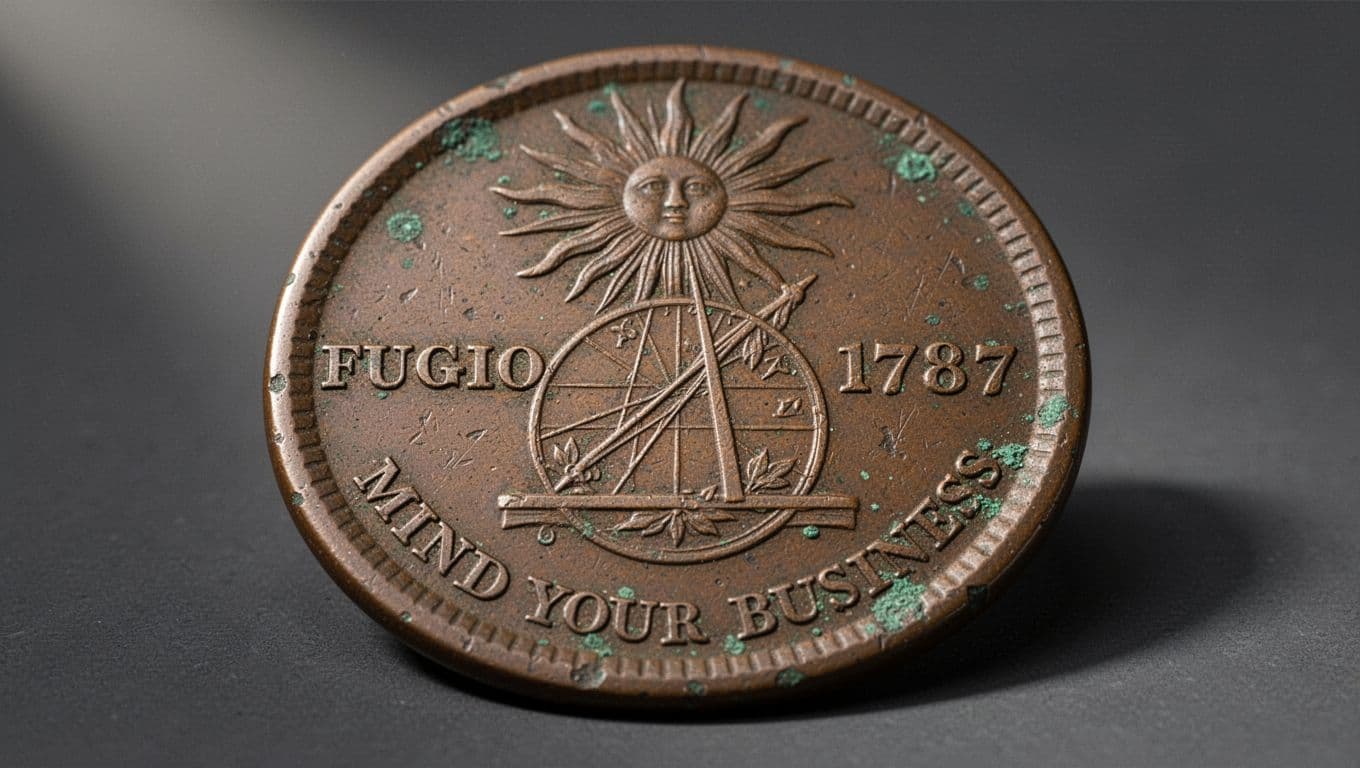
On the Fugio cent, “Mind Your Business” sits under a sundial, with the word “FUGIO” nearby. “Fugio” is Latin for “I flee,” a short punchline to the picture: time is fleeing, so pay attention to what you should be doing.
That’s the heart of the Fugio cent motto. In the late 1700s, “business” didn’t mean corporate life or stock tickers. It meant your affairs, your work, your responsibilities. Read it less like a shove and more like a warning you’d carve into a beam in your workshop: don’t waste daylight.
The design is often credited to Franklin, and the message fits his style. He liked practical moral reminders, especially ones that linked time to personal discipline. You can see why the sundial matters. It turns the motto into a complete sentence without extra words.
Collectors and historians usually describe the coin’s front and back like this:
- Obverse (front): A sundial and sun, the word “FUGIO,” the date 1787, and “MIND YOUR BUSINESS.”
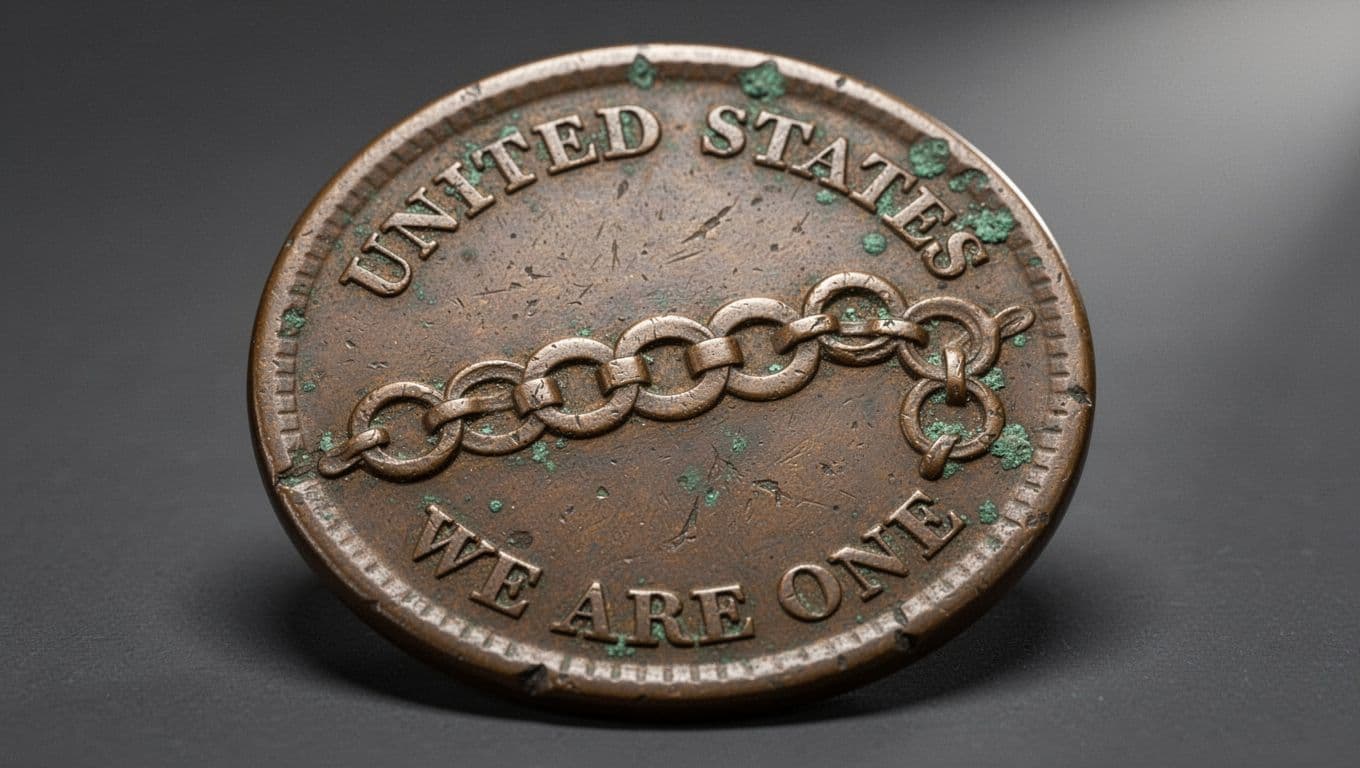
- Reverse (back): A chain of 13 linked circles and the phrases “UNITED STATES” and “WE ARE ONE.”
If you want a careful, sourced discussion of the claim that early U.S. coinage used this motto, Snopes’ fact-check on the “Mind Your Business” coin is a solid place to start. It confirms the motto is genuine while also addressing the common confusion about what counts as “first” and “official.”
The Fugio cent and the problem of calling anything “the first U.S. coin”
The internet loves a clean label: first official coin, first penny, first federal money. Early U.S. history doesn’t cooperate.
The Fugio cent was produced in 1787 during the Confederation period, before the current Constitution went into effect. It’s widely described as the first coinage authorized for the United States under the federal government of the time. It’s also sometimes called the first “official” coin in circulation. That last part is where arguments begin, because “official” can mean different things: authorized by Congress, struck at a government mint (there wasn’t one yet), or widely used day to day.
What’s well supported is the basic chain of ideas. Franklin had earlier been associated with a 1776 coin design known as the “Continental Dollar,” which also uses the “Mind Your Business” motto alongside a time-themed image. The Cato Institute’s historical explainer, About the 1776 Continental Dollar, lays out the core symbolism in plain terms: time flies, so mind your work.
The Fugio cent follows that same logic, then adds a second message on the reverse. Thirteen linked rings form a chain, paired with “WE ARE ONE.” The image isn’t subtle. It’s unity by necessity, the states tied together, for better or worse.
This is where the motto feels less quirky and more serious. The country was cash-poor, politically fragile, and running on a patchwork of currencies people didn’t always trust. A coin that basically says “Time’s going, stay on task” fits that mood.
Why the motto disappeared, and what replaced it
So why don’t modern quarters tell us to mind our business?
Part of the answer is simple: early U.S. coin designs weren’t yet locked into a single national style. The United States Mint didn’t begin striking federal coins until the 1790s, after Congress created it in 1792. Once a central mint existed, coin design moved toward more consistent symbols, Liberty, national emblems, and short Latin phrases.
Another part is that mottos tend to reflect what a government wants to project. “Mind Your Business” is personal. It speaks to the individual citizen. Later mottos often aimed higher, unity, sovereignty, faith, and national identity.
It’s also easy to forget that the Fugio cent’s message wasn’t only the motto. The full “lesson” is the pair:
- The sundial side pushes individual responsibility, time is slipping away.
- The chain side pushes collective responsibility, the states are linked.
If you want a modern write-up that focuses on the symbolic “hidden message” angle, the Foundation for Economic Education has an accessible article, The Hidden Message on Ben Franklin’s Fugio Cent. It’s commentary rather than an archive, but it captures how many readers interpret Franklin’s plainspoken style.
Today, the motto survives mostly as a numismatic curiosity, and as a reminder that early America sometimes spoke in a voice that feels startlingly direct.
Conclusion: a small motto that still feels oddly modern
“Mind Your Business” on a U.S. coin isn’t folklore. It’s a real motto tied to early American coin designs, especially the Fugio cent, where time imagery and practical advice share the same face. The meaning wasn’t “stay out of other people’s lives,” at least not mainly. It was closer to “take care of your work, because time doesn’t wait.”
If you ever hold one of these coins, or even just study a clear photo, it’s hard not to feel the weight of it. A young country, short on money and long on problems, stamped a reminder to use your time well. That message hasn’t gotten any less true.