

How Insects Cracked History’s First Forensic Case
A fly doesn’t sound like a hero until you hear about the fly that solved a murder. It’s the kind of detail you’d brush away, literally. But in a famous case from 13th-century China, a cluster of flies did what witnesses wouldn’t: they pointed at the killer. This is the earliest case of forensic entomology.
This story often gets called history’s first forensic case solved with insects, and it still feels oddly modern. No magic, no myths, just observation, patience, and an uncomfortable truth about what bugs are drawn to.
A murder in a rice field and a magistrate with a simple test
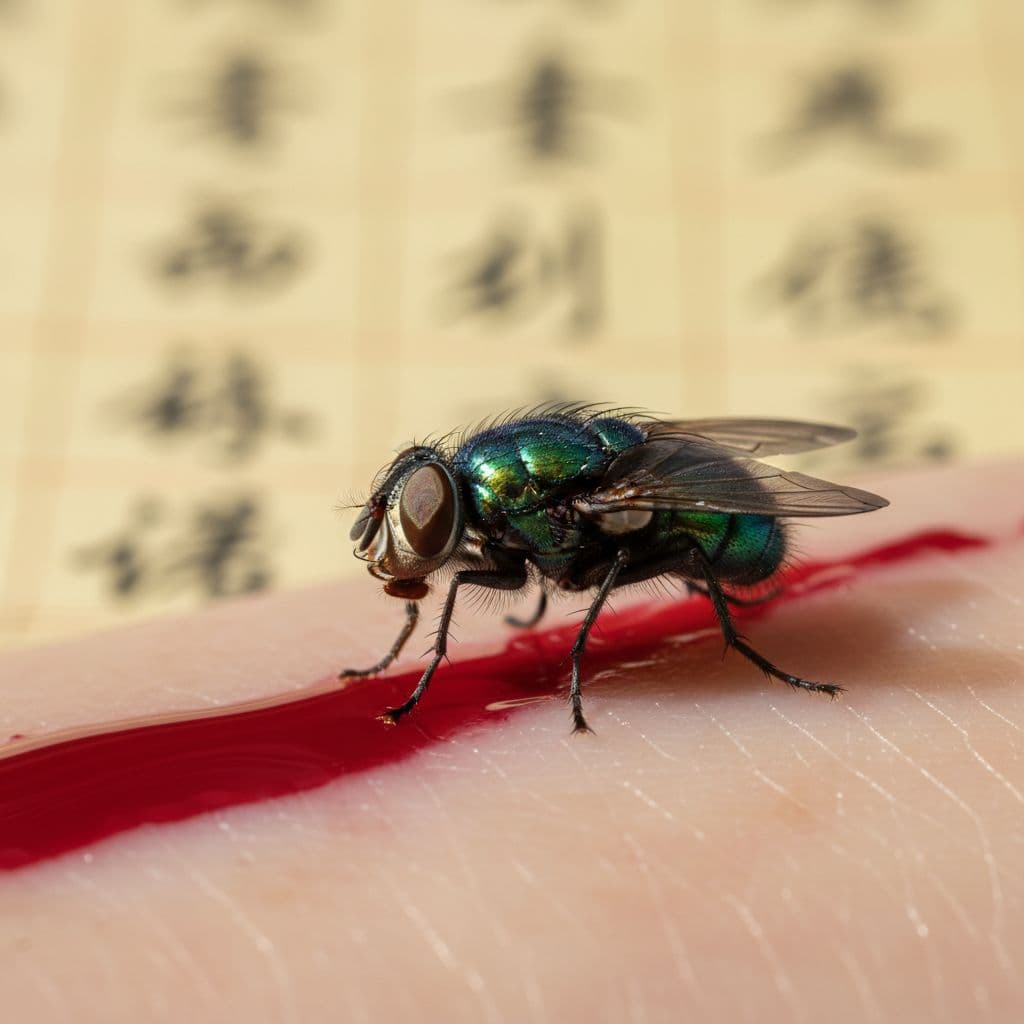 A fly drawn to blood residue, a small clue with big consequences, created with AI.
Around 1235, a farmer was found slashed to death, likely with a sickle, which wasn’t exactly helpful since sickles were everywhere. The local magistrate, Song Ci (also written Sung Tz’u), faced a problem that still shows up in crime stories: everyone had the same tool, and no one was talking.
So he tried something almost embarrassingly simple. He ordered the villagers to bring their sickles and place them on the ground in the open. At a glance, they looked clean. The suspected murderer had washed his blade, maybe thinking that ended the risk.
Then the flies arrived.
They didn’t spread out evenly. They gathered on one sickle, swarming it as if it had been marked. That attention wasn’t random; flies can detect tiny traces of blood and tissue you can’t see. Confronted with the “fly verdict,” the sickle’s owner confessed. I find that part a little chilling, because it suggests the suspect knew exactly why the flies chose his tool.
Why flies made it evidence, and why that still works
This is the core idea behind forensic entomology, the use of insects in legal investigations. Flies, especially blow flies, tend to show up fast after injury or death. They’re not moral witnesses, but they’re consistent ones.
Investigators today use insect behavior in a few practical ways:
- Time since death: Blow fly larvae develop in stages, and those stages help estimate how long a body has been exposed.
- Whether a body was moved: Different insects appear in a rough order, and the mix of species can hint that a body wasn’t originally found where it decomposed.
- Trace links: In some cases, insects can carry material (even DNA) that supports other evidence.
Song Ci later recorded the case in his 1247 forensic manual, Washing Away of Wrongs, often described as the first guidebook for death investigation. It covered wounds, scenes, and careful inspection, the kind of boring detail that solves real cases.
From one sickle to a whole science of forensic entomology
The “fly and sickle” case didn’t instantly create modern forensics, but it set a pattern: let nature talk when people won’t. Centuries later, researchers like Francesco Redi helped prove that maggots come from fly eggs, not spontaneous decay. In the 1800s, doctors began using insects on bodies to support timelines in court. Since the late 20th century, the field has grown into a specialized part of investigations.
The strange part is how familiar it feels. A crowd, a test, a tiny detail, and a confession.
In the end, the lesson is simple and a bit unsettling: insects notice what we miss. Next time you swat a fly away, it’s worth remembering that its senses are built for secrets.