

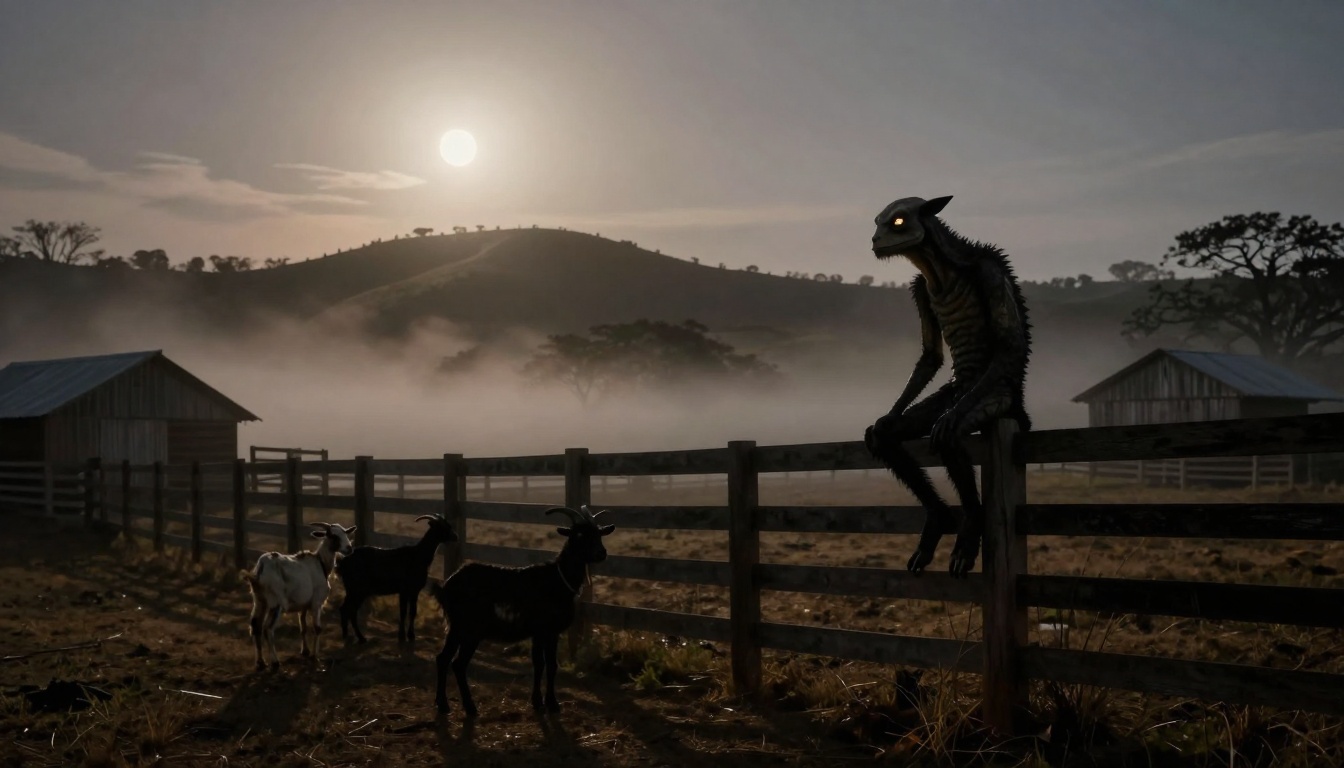
Chupacabra: Fact or Folklore
The Chupacabra sits in that uncomfortable space where real loss meets a story that won’t stop growing. Farmers wake up to dead goats or chickens, neighbors trade theories, and suddenly, a messy, explainable problem starts wearing a monster mask.
The name means “goat-sucker,” and the global version of the legend really took off in Puerto Rico in the mid-1990s. That matters, because this isn’t some ancient creature crawling out of prehistory. It’s modern. It spreads the way modern things spread: fast, emotional, and sticky.
So what can we actually verify, what stays disputed, and why did this myth travel so far so quickly? If you want the calm answer, it’s here. If you want the scary answer, it’s also here, just not in the way people think.
From Puerto Rico panic to global monster, how the Chupacabra legend took shape

The first thing to get straight is the timeline. The Chupacabra story doesn’t spring from dusty folklore, as people sometimes assume. It shows up like a pop song that hits at the right moment, then refuses to leave your head.
Reports in Puerto Rico in 1995 became the template. After that, the story traveled through the Caribbean and Latin America, then into the U.S., especially places where ranch life and predator pressure are already part of the weekly stress budget.
And here’s the trick. As the story moved, the creature changed shape. That’s not a small detail. It’s the whole thing.
1995, Puerto Rico, the first big wave of reports, and the “goat-sucker” name
In Puerto Rico, people reported livestock found dead, often goats and chickens. Some carcasses were described with puncture wounds, usually around the neck or chest. Then came the signature claim: “drained of blood.”
That detail is hard to confirm just by looking. After death, blood can pool, soak into soil, or be consumed by insects and scavengers. A scene can look “dry” and still involve normal blood volume. But in the middle of fear and rumor, “no blood” becomes a headline, not a hypothesis.
The label “Chupacabra” caught on in 1995 and quickly became a catch-all. If something weird happened to an animal, the story offered a ready-made villain. People didn’t need proof; they needed a name that fit the dread.
Fact or Fiction — Chupacabra Claims
| Claim | Verdict | What’s Really Going On |
|---|---|---|
| “Chupacabra” means goat-sucker. | Fact | The name comes straight from Spanish livestock folklore. |
| Chupacabras are a confirmed unknown species. | Fiction | No physical evidence supports the existence of a new animal. |
| Two puncture wounds prove a chupacabra attack. | Unclear | Common predators can leave similar marks. |
| Victims are always drained of blood. | Fiction | Blood pooling after death explains most reports. |
| Early sightings described reptile-like creatures. | Fact | Many 1990s Puerto Rico reports used alien-style imagery. |
| Modern sightings usually involve sick canines. | Fact | Mange can make familiar animals look unrecognizable. |
| Folklore alone explains every case. | Partly | Fear spreads stories, but real predators cause real damage. |
Why the creature’s look keeps changing, from spiky biped to hairless canine
Early descriptions of Puerto Rico often sounded like an upright, alien-like animal, sometimes with spines or a ridged back. Later reports in Mexico and the U.S. Southwest favored a four-legged, dog-like creature, often described as hairless and sickly.
That shift isn’t just “regional flavor.” It tracks with a very human problem: memory plus media. One widely discussed line of investigation points out that an early eyewitness sketch and description had strong similarities to a creature seen in the 1995 sci-fi film Species, which had recently played locally. People don’t like hearing that, because it feels insulting, but it’s not an insult. It’s how brains work under stress, when a vivid image has already moved in rent-free.
For a grounded summary of how the legend morphed, including the disease angle, see National Geographic’s reporting on the myth’s evolution and likely explanations in Chupacabra legend and scientific explanation.
What investigators actually find when there’s a body to test
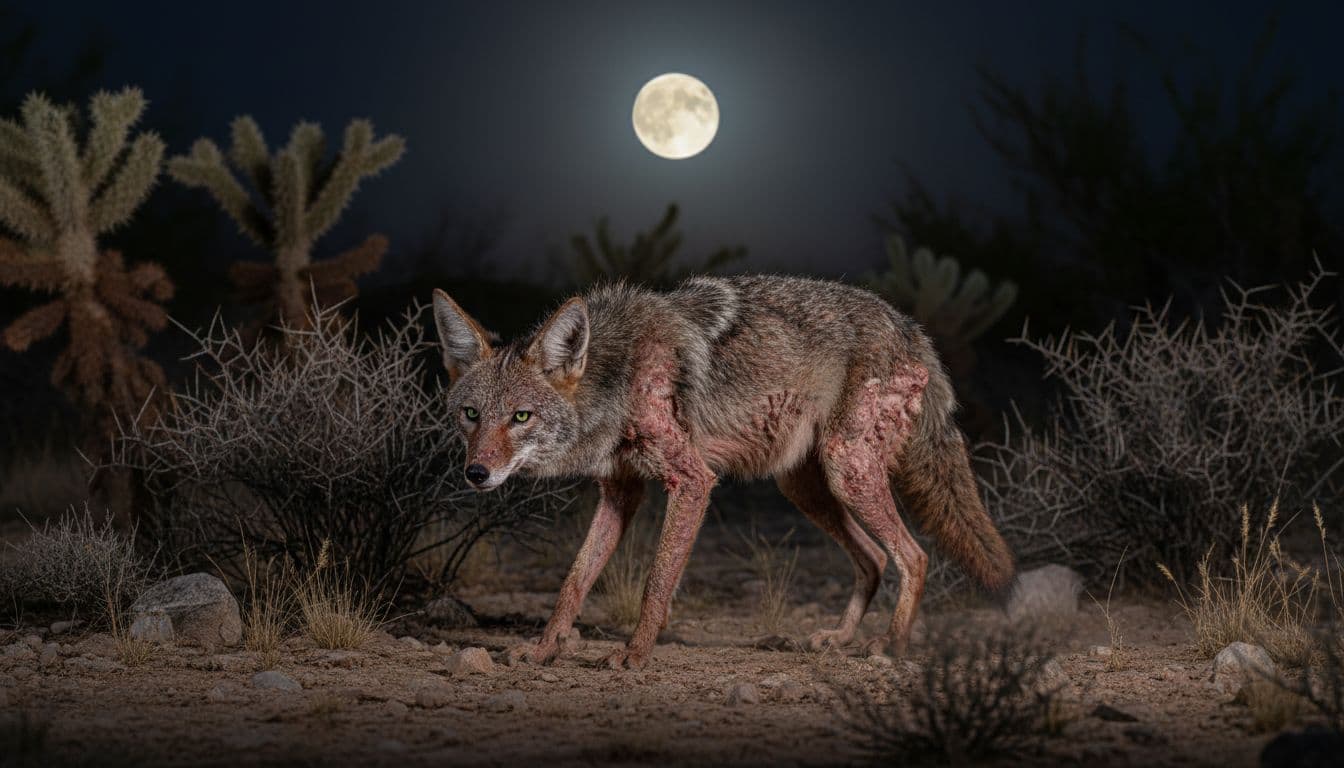
Stories are loud. Specimens are quiet. When investigators actually have an animal to examine, the results are usually stubbornly ordinary.
Across many claimed “Chupacabra” bodies in the U.S. and Mexico, DNA testing has repeatedly identified familiar canids, such as coyotes, dogs, or close mixes. That doesn’t solve every livestock death, but it does undercut the idea of a hidden breeding population of unknown monsters moving through suburbs unnoticed.
This is the part people skip, because it’s less fun. It’s also the part that matters most if your animals are the ones paying the price.
Mange can make coyotes and dogs look “unrecognizable” and add fuel to sightings
Sarcoptic mange is caused by mites that burrow into the skin. In plain terms, it can wreck an animal’s coat and body condition. You can see:
- Patchy hair loss, sometimes near total baldness
- Thickened, crusted skin that looks “scaly.”
- Weight loss and a gaunt shape
- Odd posture or stiff movement from discomfort
A sick predator may take easier opportunities. That can mean raiding coops, targeting young animals, or approaching human spaces where normal wild behavior breaks down. It’s not supernatural, it’s desperate.
People see a hairless, limping canine under a porch light, and their brain tries to label it. The Chupacabra label is sitting right there, waiting like a cheap plastic mask at a party store.
The “blood-drained” detail, what predation and biology can explain
Predators often attack the neck. A neck bite can leave puncture marks. After death, blood doesn’t always present the way people expect in movies. It can settle internally, seep into the ground, or become less visible over time.
Some investigated cases have included necropsies that did not support the idea of total blood loss. That doesn’t mean witnesses lied. It means the eye test isn’t a lab test, and grief plus shock can make anyone swear they saw something that isn’t medically supported.
If you want a practical, livestock-focused explanation written for landowners (not for internet arguments), Texas A&M AgriLife Extension has a concise resource: The science behind “El Chupacabra”.
So is the Chupacabra fact or folklore, a practical way to judge new claims
If “fact” means a confirmed unknown species, the evidence isn’t there. As of early 2026, public reporting does not show confirmed Chupacabra cases in the U.S., Mexico, or Puerto Rico, and recent claims still tend to collapse into misidentification, disease, or routine predation when checked carefully.
If “folklore” means a story that grows around real stress, real dead animals, and real uncertainty, then yes, it’s folklore. Powerful folklore. The kind that moves faster than paperwork.
A quick reality check list: tracks, bite patterns, photos, and vet reports
When livestock are attacked, don’t argue with the story first. Secure evidence first.
- Secure the scene quickly so tracks and prints aren’t trampled.
- Photograph tracks with scale, using a coin or a ruler for size reference.
- Document time and location (weather, lighting, fencing, nearby water).
- Photograph wounds up close and from a distance before moving the body.
- Request a necropsy from a veterinarian when possible.
- Contact local wildlife officials to help ID predators and patterns.
- Set trail cameras aimed at entry points, not just the carcass.
This isn’t about “proving someone wrong.” It’s about giving reality a fighting chance.
Why does the myth last, even when science points to ordinary animals
The Chupacabra sticks because it does emotional work. It gives shape to a problem that feels unfair. Predators kill, disease spreads, fences fail, and people feel watched by systems that don’t show up until after the damage is done.
In rural communities, losses can feel personal and economic at the same time. Add distrust of authorities, a long history of conspiracy talk (sometimes earned), and the way the internet rewards the weirdest explanation, and you get a myth that reproduces without needing a breeding pair.
Also, a single vivid description can become shared property. Once the “spiky alien” or the “hairless dog-thing” is in the public mind, each new odd carcass gets forced into that mold. Humans hate loose ends. A monster is a neat ending, even when it’s the wrong one.
Conclusion
The Chupacabra is a modern legend, built in the mid-1990s and shaped by media, rumor, and changing regional descriptions. The livestock losses are real, and they matter, but the best-documented explanations usually point to known animals and known problems, often canids, sometimes sick ones.
When there’s a body to test, DNA work and veterinary exams tend to pull the story back to earth. That’s not disappointing, it’s useful. It tells you what to protect against.
Stay open-minded, but stay disciplined. Treat every new claim like a case file, not a campfire tale. The best way to honor the mystery is to demand evidence, then take care of the living animals in your care.
Chupacabra FAQ
Quick answers to the questions people ask after hearing the legend.
What does “chupacabra” mean?
“Chupacabra” is Spanish for “goat-sucker.” The name comes from reports that the creature attacks livestock, especially goats, and leaves them looking “drained.”
Where did the chupacabra story start?
The modern legend is usually traced to Puerto Rico in the mid-1990s, after a wave of livestock deaths that locals couldn’t easily explain at the time.
What is the chupacabra supposed to look like?
Descriptions split into two main versions: an “alien/reptile-like” creature in early Puerto Rico reports, and a more dog-like animal in later sightings across the U.S. and northern Mexico.
Is there any real evidence the chupacabra exists?
There’s no verified scientific proof of a new creature. Most “hard evidence” cases end up being misidentified animals, hoaxes, or normal predators blamed during a local panic.
If it’s not real, what’s actually killing the animals?
The most common explanations are dogs, coyotes, foxes, feral animals, or other predators. In some regions, sick canids with mange look strange enough that people assume “monster.”
Why do people say the animals were “drained of blood”?
After death, blood can pool inside the body or settle away from visible areas. Add puncture wounds, stress, and a scary story spreading fast, and “drained” becomes the headline people remember.
Why are there two puncture marks in so many stories?
Two punctures can come from common predators biting the neck, or from scavenging after the animal is already down. It sounds “vampire,” but it also fits basic animal behavior.
How do you protect livestock from “chupacabra-style” attacks?
Start with the boring stuff that works: secure night enclosures, repair gaps in fencing, use motion lights, remove food waste that attracts predators, and check for tracks or entry points after any attack.




Some of my Hispanic students have mentioned this but the language barrier made so I didn’t understand what they were talking about. I appeased them by acting like I understood but I had no clue.
Thanks for shedding light on this. I don’t know if it’s as significant as, say Big Foot but people do like drama, whether it’s real, imagined, or a combination of the two.
It was a good read.
Bob
Growing up in Texas, I heard many different stories and personal accounts of the Chupacabra. Like any legend, it must be taken with a grain of salt, but sometimes animals do appear dead in rather strange ways and that does tend to add to speculation of the truth.
Michael